Cardinal Seán's Blog

Cardinal Seán shares his reflections & experiences.

Archive for 2007/01


Marching for Life

It has indeed been a very busy, but rewarding, week with a trip to the March for Life in Washington D.C., Ecumenical Prayer Service and Mass for those organizing the upcoming Men�s and Women�s Conferences. The conferences will be held on March 17 and 18 respectively.

The Mass for those organizing the conferences was held on Saturday morning at St. Michael Parish in Bedford with pastor Father Mark Sheehan. We celebrated the Mass of St. Sebastian, who is certainly a wonderful role model for men. He was martyred, not once, but twice.

Sebastian was serving in the Roman army in the late third century. His military post exposed him to many Christians who were about to be martyred during the Diocletian persecution. He comforted them, encouraging them to remain resolute in their faith and not apostatize. He also converted many to Christianity. Eventually, he was discovered and sent to be executed by archers (sort of an ancient firing squad.) His body was riddled with arrows and he was left for dead � but he was not. Once he recovered from his wounds, he confronted the emperor for his cruelty against Christians, for which the emperor ordered him seized and beaten to death with cudgels.

The Mass at St. Michael�s was a wonderful event, with many parishioners in attendance, but also the captains from the various parishes who are working on the Men�s Conference as well as some of the women who are involved with the Women�s Conference, particularly Jennifer Schiller from Holliston. She addressed the group at the breakfast and was encouraging the men to try to identify people in the parishes to help her with the women�s conference. The men�s conference has sort of an infrastructure now that the women�s conference does not yet have. Although, the women don�t need as much encouragement to go to something like this as we found out last year when in a matter of weeks they were able to bring together a wonderful conference!
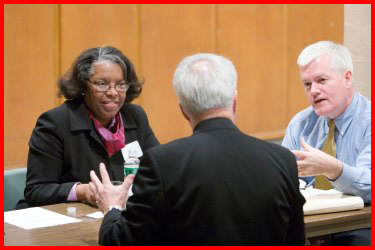
bcmccaptains01.jpg

I thanked the captains for their efforts in organizing the Conferences and I told them that their personal invitation to others will make the difference in many instances between whether that person will become an active member of the Church or not. Many people are just waiting to be invited. In this, I told them, each of us has a particular responsibility and an opportunity to make a difference, to reach out and to help people to find their way to a community of faith and a relationship to the Lord with our brothers and sisters.
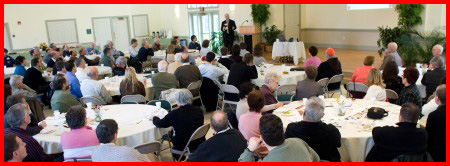
bcmccaptains03.jpg

The presentation of Scot Landry, one of the co-founders of the Men’s Conference

We live in a world that is so individualistic, and many people see religion as being a very personal spirituality. But we know that Jesus came to establish a community of faith, a Church of people. It is in that context that we are able to fulfill our mission as God�s people, so we need to come together. As I also told the people at the march in Washington, the experience of loving the same things � loving the Lord, loving the Church, loving the sacraments, loving the Holy Father, loving the Blessed Virgin � binds us together. The solidarity is so strong when we love the same things and the same people! That�s what the Church is all about, and to build that solidarity we must invite others to know this reality and to experience it.

- – -

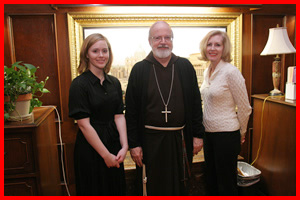
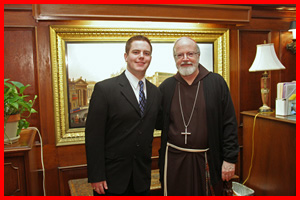
On Saturday evening Jan. 20, I celebrated Mass at the eighth annual Cardinal O’Connor Conference on Life, at Dahlgren Chapel on the campus of Georgetown University. Bridget Bowes, a Georgetown senior and Director of the conference, and Mr. Joseph Zwosta, also a senior and chancellor for the University Council of the Knights of Columbus, welcomed me to this important occasion of witness of our committment to life. The Conference was sponsored by Georgetown University Right to Life, a student organization, University Faculty for Life, and the University Council of the Knights.

Actually, Bridgett and I studied at the same Catholic grade school, St. Gabriel’s in Pittsburgh, which still charges no tuition to the students.
georgetown_247-4763_img.jpg

Bridgett Bowes, director of the Georgetown Right to Life Chapter
with her mother Mary Jane Bowes, a Pennsylvania Superior Court justice
georgetown_247-4760_img.jpg

Joseph Zwosta, chancellor of the Georgetown Knights of Columbus

Georgetown is the first Catholic university in the United States, founded by our first American bishop John Carroll in 1789.

bishopjohncarroll001.jpg

This card portraying Bishop Carroll is found
in the Boston archdiocesan archives

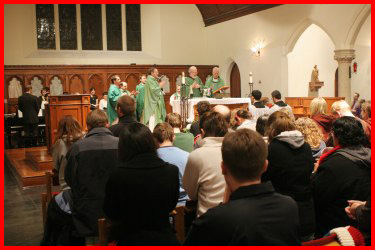
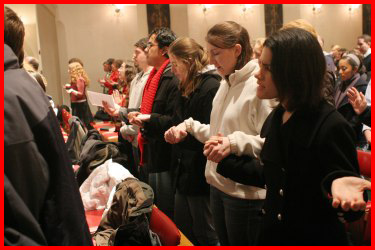
More than 600 people registered for the conference, primarily college and university students participating in the March for Life. Mr. Carl Anderson, Supreme Knight of the Knights of Columbus, and Dr. Helen Alvare, professor at the Catholic University School of Law, were among the featured speakers for the weekend program. The Mass was an uplifting occasion and a sign of our well founded hope for the future as hundreds of students gathered to celebrate their faith and to thank God for the precious gift of life.
georgetown_247-4712_img.JPG

georgetown_247-4730_img.JPG

georgetown_247-4712_img.JPG

Many of the Sisters of Life, the community that was founded by Cardinal O�Connor were there. I was also pleased that Father Peter Uglietto, rector of Blessed John XXIII National Seminary, was able to be there with me as well.

georgetown_246-4673_img.JPG

The Sisters of Life

- – -

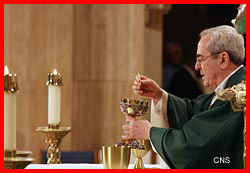
The following day, Sunday, was the Vigil Mass at the basilica, celebrated by Cardinal Rigali from Philadelphia. There were literally hundreds of bishops, priests and seminarians, including our seminarians from Blessed John XXIII.
vigil5_web.jpg

Cardinal Rigali celebrating Mass

vig7_web.jpg

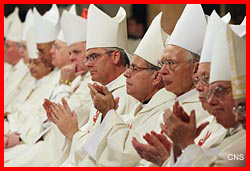
There were many bishops there

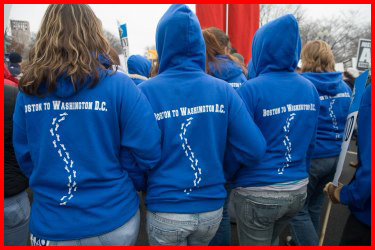
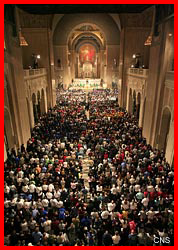
Thousands of people gathered in the basilica and hundreds of Catholics came from Boston. There were many seminarians, Catholic school students and parishioners who traveled by bus from this archdiocese.
vigil3_web.jpg

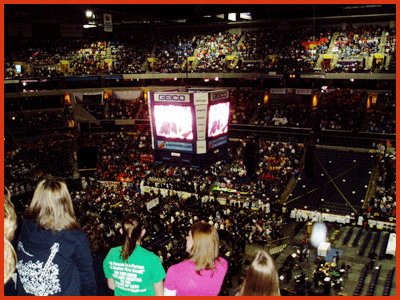
You can see, the Basilica was packed

Marianne Luthin from the Pro-Life Office, Fathers Dan Hennessey and Michael Harrington from the Vocations Office and Steve Colella from the Office of Youth Ministry all worked together to promote the events of the weekend.

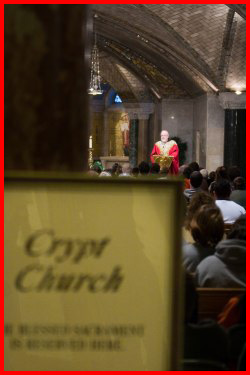
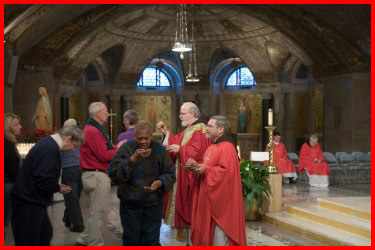
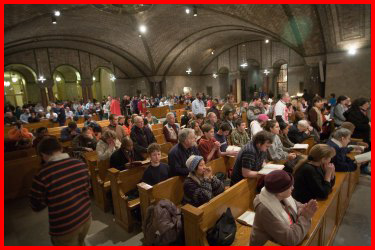
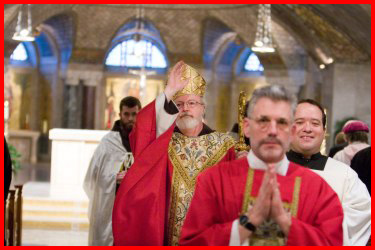
I was also asked to celebrate a Mass in the crypt of the basilica the morning of the march. The Mass was for those who arrived on Monday morning and were not able to attend the Mass on Sunday. These were people who came from Pennsylvania, Ohio, places where they had left early in the morning. The crypt was packed for that.
crypt.jpg

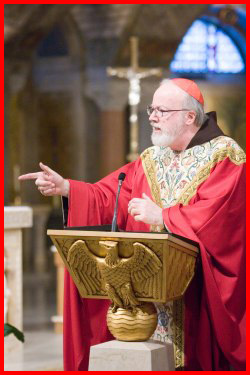
I’d like to share some highlights of my homily with you:

I have read much about a film in the movie theaters today called the Children of Men. The story is about a world twenty years from now. A demographic winter has set in. A group of people resisting the culture of death form the Human Project. The storyline describes a world with no babies, an epidemic of infertility, a hopeless violent world. Finally, one baby is born in secret. During a battle scene, the baby cries and suddenly everyone stops fighting, women want to touch the baby, soldiers kneel and make the sign of the cross. In the midst of the violence and despair, the baby becomes a sign of hope.

crypt__1_img_0434.jpg

A recent article in the British news magazine, The Economist, indicates the present demographic crisis in the West. In the European community there is 1.4 fertility rate � that means that in five years deaths will outnumber births. The most prosperous areas have less children. The fertility rate in Italy and Spain is 1.2, that translates into a population in twenty years to half of what it is today. And the typical citizen will have no brothers and sisters, no cousins, no aunts and uncles. The British news magazine went on to say that our situation in the United States is better because Americans are more devout � we are churchgoers and churchgoers get married and have families. The Churches in the United States are family friendly and nurture family life. They even quote Hilary �It take a village to raise a child� but they added the Church is that village. I like that. I believe it is true. One of the reasons the Church defends marriage in the face of divorce, cohabitation and redefinition of marriage by the Massachusetts Supreme Judicial Court is that marriage and family are the Sanctuary of Life and when that sanctuary is violated, life liberty and the pursuit of happiness, real happiness, society itself is at risk.

Church is a bastion of defense against the culture of death. In terms of the film Children of Men we are �the human project� � the alternative is the culture of death. As the populations of the Western world age, we will see that the generation of parents that aborted their own children, will be euthanized by the children who survived.

A few years ago I saw a photograph in a newspaper or in a news magazine that I found very chilling. A man bound and gagged was kneeling with a gun in the hand of a policeman aimed at his head.
crypt__1_img_0431.jpg

The story line was that this was a Chinese prisoner, perhaps a criminal who was being executed to harvest his organs. I like to think that decent people would be repulsed by this practice, but I do not know. I was horrified to see how American tabloids reported on the execution of Saddam Hussein in a gleeful and jocular manner � making a joke out of an execution � calling the condemned man the king of swing. Such coarseness is something one would associate with the mobs in the Colosseum thirsty for the sight of blood.

Most of us prefer to be removed from such violence. It is considered more civilized to push a button that will cause a bomb to drop on some distant target that we do not have to see or hear the screams of pain or see the burning flesh. That is why the same decent people who would blanche at the execution of the Chinese prisoner can be the enthusiastic supporters of stem cell research � which does not kill a criminal in a far off land but kills innocent human life in our own country funded by our taxes or the monies of corporations whose products we patronize.
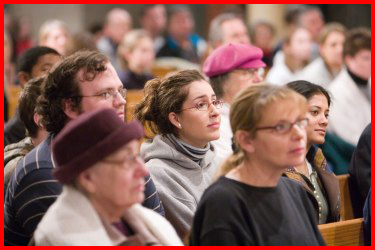
crypt__1_img_0404.jpg

We have come to embrace a new morality that is dehumanizing and dangerous. The new morality is: the ends justify the means. We all want to see a Michael Fox or a Pope John Paul II be cured of Parkinson�s disease. We would all want to see a Christopher Reeve get up out of a wheelchair and walk. We all want to see that, but we do not want to shoot the pickpocket in the head to do it nor do we want to trample innocent human life to achieve so noble an end.
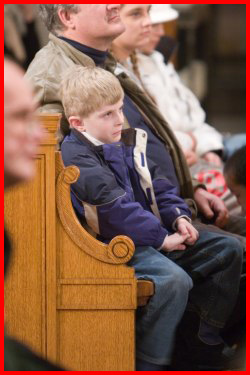
crypt__1_img_0419.jpg

What is most frustrating is that there are moral, ethical experimentations that can get to the place we all want. I often think of those high speed chases where many innocent bystanders have been killed, because someone was trying to catch a bank robber. Was it worth it?

The irony of stem cell research is that the ethical and moral research that does not destroy human life or stoop to cloning has brought about many successes and cures. The immoral destruction of embryos to this point has achieved nothing despite all the media hype.
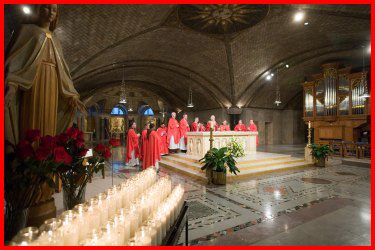
crypt__img_9979.jpg

We all want the cures, but the ends does not justify the means. We need to raise the volume in announcing the Gospel of Life. It must not be a strident and hateful scream but a courageous proclamation of the Gospel of Life by witnesses whose lives are transformed by faith, love and a desire to serve. The most eloquent prophet of the Gospel of Life was Mother Teresa.
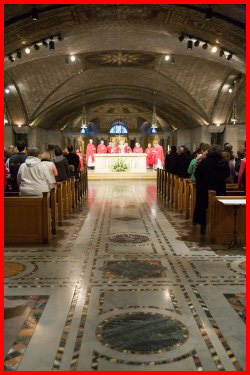
crypt__img_9998.jpg

We have become complacent, Bishop McDonnell is always quoting a phrase from Alexander Pope that is very applicable to our modern moral crisis. The English poet wrote: �Vice is a monster of so frightful mien, as to be hated needs but to be seen; Yet seen too oft, familiar with her face, We first endure, then pity, then embrace.�
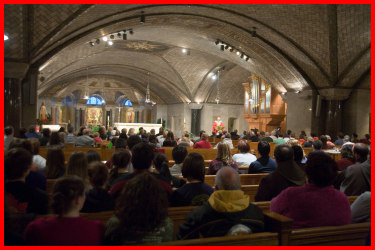
crypt__img_9953.jpg

Where is the outrage? As a country we have become callous to the horrors of abortion to human life. The greatest parallel is with slavery in the antebellum period of our history. The people convinced themselves that slavery was necessary, justifiable for economic, social reasons. Today our society is turning a blind eye to abortion and saying that now the ends justify the means. �The losers in this sea charge will be those who are elderly, poor, disabled and politically marginalized. None of these pass the utility test; and yet, they at least have a presence. They at least have the possibility of organizing to be heard. Those who are unborn, infirmed and terminally ill have no such advantage. They have no �utility,� and worse they have no voice. As we tinker with the beginning, the end and even the intimate cell structure of life, we tinker with our own identity as a free nation dedicated to the dignity of the human person. When American political life becomes an experiment on them rather than for and by them, it will no longer be worth conducting.
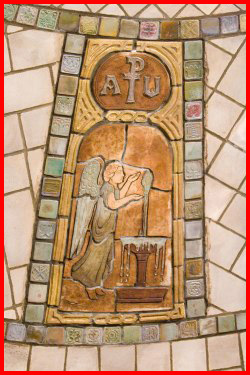
crypt__1_img_0480.jpg

The mosaics of the crypt are very detailed

I thank you for being here today, for defending the Gospel of Life. We must work together to establish a civilization of love where there is room at the table of life for all of our brothers and sisters.

The Eucharist we share is God making a gift of Himself so that we can have the strength to make a gift of ourselves to God and to one another.
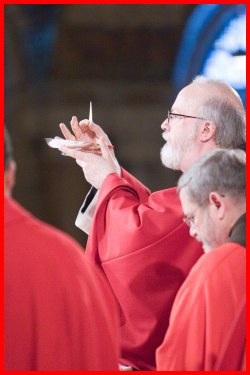
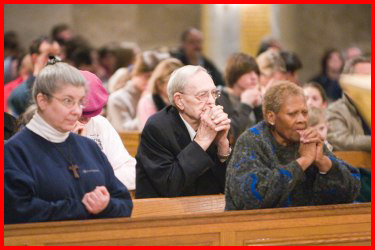
crypt__1_img_0473.jpg

crypt__1_img_0475.jpg

The choice is clear either Civilization of Love or Culture of Death. I am hopeful because Love is stronger than death.

The average life span is 25,000 days. We want to live the days we have left on this planet for God and for our Brothers and Sisters. We are not on a solo flight, we are part of a team, we must work together to fulfill our mission here.
crypt__img_0004.jpg

The Eucharist is a special moment in our life. We can miss it if we are too addicted to entertainment. If we gather here in faith to worship the Lord, this Eucharist, the living word of God, the Bread of Life, and the witness of fellow disciples is where we acquire the strength to do what Jesus did, to love the way He loved, to serve the way He served, to suffer the way He suffered.
crypt__img_0010.jpg

And yes, some people will think that we are crazy but even Jesus� relatives though that Jesus was out of His mind.

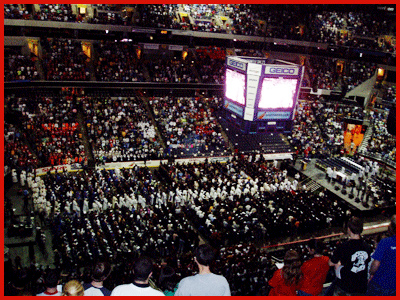
The March for Life has always been an extraordinary event in the life of the Church in the United States, and it�s an event that makes a very deep impression on the young people who are there. For young Catholics, who often feel alone in professing the faith, to be in the company of thousands of young people who are committed to the Church, to the sacraments and to defending the Gospel of life, it�s just an exhilarating experience. I�ve always encouraged our high schools and parishes to try to make it possible for many young people to go to the Pro-Life March in Washington and be a part of the wonderful youth Mass there at the MCI Center.

A couple of photos of the youth rally from the Office of Youth Ministry’s web site:
lifemass3.jpg

lifemass1.jpg

Last year after admitting 20,000 youth, they had to turn them away. 20,000 youth again filled that center this year and more filled another huge center on the day of the march.
crypt_1_img_0486.jpg

I have been at every march since it began in 1974. Obviously, I was in Washington the first years, but I have always made it a point to return and be part of this event, which I think is a very important witness and a reminder to Catholics.
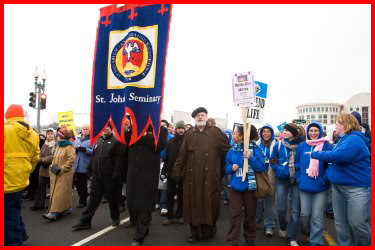
marchlife07__img_0476.jpg

Marching with the seminarians and groups from Boston
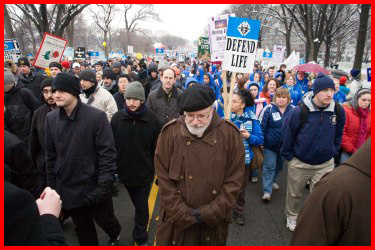
marchlife07__img_0507.jpg

Sometimes Catholics are confused even by Catholic politicians who try to give the impression that because America is a pluralistic society, we have to accept abortion as the law of the land. Just because it�s a pluralistic society, it doesn�t mean we must accept something that is an egregious breach of human rights in the same way that we could not accept the racial segregation that once existed in the country. It was the religious community that was the strongest in helping to change that situation.
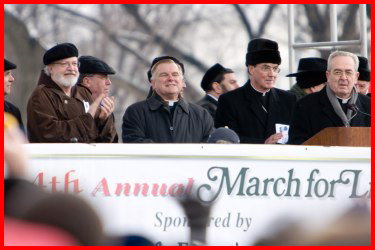
marchlife07__1_img_0585.jpg

Many bishops were there for the pre-march rally on the National Mall

The witness of having many thousands of Catholics and a big percentage of the leadership of the Catholic Church together on the anniversary of Roe v. Wade, I think, is a very important testimony to the fact that this issue is at the center of Catholic social teaching. You can talk about economic justice, racial equality, women�s rights and many other issues that are important. But if we don�t allow a person to be born, then they�re never going to have the opportunity to enjoy all of those other rights that we also defend. So there�s something very basic and very central about this teaching, and for that reason the Church must continue to be a voice for the culture of life.
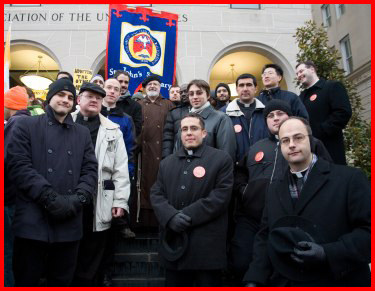
marchlife07__img_0565.jpg

A photo with our seminarians

The fact that EWTN televises the Mass and the march is also a way of letting Catholics throughout the United States feel a part of what is happening there and identify with this important effort to witness to the Gospel of life.

During these decades, I�ve seen the pro-life movement grow. I�ve seen people come to join us from other religious backgrounds. At the beginning, it was a very Catholic event and now there are Jews, Orthodox Christians, Protestants and Mormons � just a whole spectrum of the religious landscape in the United States is represented there.
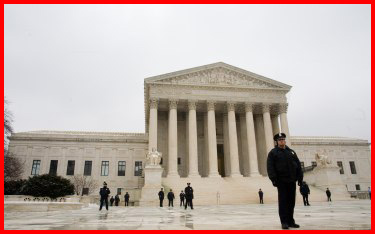
marchlife07__img_0622.jpg

The Supreme Court, the end-point of the march
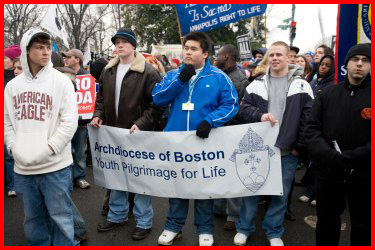
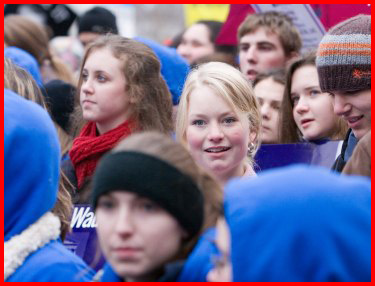
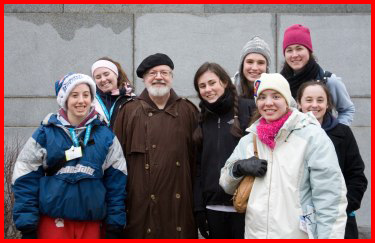
I also find very consoling that it�s become a very young crowd. Before, it was the older Catholics, very faithful Catholics, but now we see young people there, people who were born after abortion was legalized. Children who could have been aborted themselves, legally. The fact that all these young people are on board is a clear sign that the issue is not going to go away.

marchlife07__img_0563.jpg

It was great to see so many young faces
marchlife07__img_0605.jpg

marchlife07__1_img_0625.jpg

marchlife07__img_0491.jpg

marchlife07__img_0540.jpg

marchlife07__img_0155.jpg

marchlife07__img_0128.jpg

marchlife07__img_0126.jpg

marchlife07__img_0119.jpg

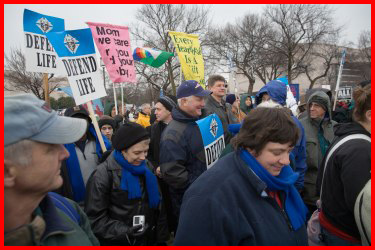
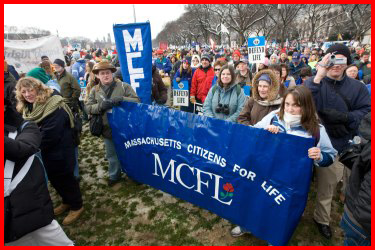
The delegation from the Massachusetts Citizens for Life

- – -

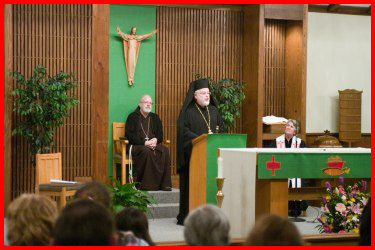
On Wednesday the 24th, we had an Ecumenical Prayer Service to mark the Week of Prayer for Christian Unity at St. John Chrysostom Parish in West Roxbury. The pastor, Father David Michael, did a wonderful job in bringing it together, and Father Ed O�Flaherty, director of Ecumenical and Interreligious Affairs, designed the program. We had readings, songs and Metropolitan Methodios of the Greek Orthodox Church gave a reflection. He had just returned from being part of the pope�s visit to Istanbul.
christnunitywk_crw_6505.jpg

Metropolitan Methodios delivers his reflection

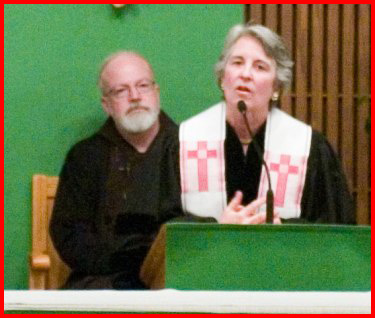
I was pleased that so many people came to the service. The Church was filled, and there were representatives from the Council of Churches. Rev. Diane Kessler, head of the council for over 30 years, was there. We all thanked her for the job she has done. I praised her for her wonderful work on behalf of unity. She never trivializes the differences between the churches but at the same time is always able to bring us together in friendship. Her role has been extremely positive, and we were happy that she was recognized for her work.
christnunitywk_crw_6526_2.jpg

Rev. Kessler

During the service, they asked me to recite the Apostles Creed in Latin to represent the Western Church and Metropolitan Methodios recited it in Greek. We then invited all the assembly to recite it in English.

I told the people that an old tradition in the Church says that that this creed was composed by the apostles on Pentecost, and each apostle wrote one phrase for the creed. Now, there�s no historical proof of that. But we do have indications that this creed was used in the baptismal ceremonies in the very early Church. So, tradition and the fact that it�s called the Apostles Creed shows just how ancient it is.

We are people of the creed by our faith in God, in the Trinity, in the incarnation, the resurrection of Jesus and the virgin birth. All our faith is there in this simple prayer that for 2,000 years Christians have been praying � Catholics, then Orthodox and then Protestants. We�ve all prayed this same creed, and it is one of the things that unites us as Christians � as Jesus� followers. I was very pleased to see that used as part of our Ecumenical Service.

The Creed in Latin:

Credo in Deum Patrem omnipotentem; Creatorem coeli et terrae.

Et in Jesum Christum, Filium ejus unicum, Dominum nostrum; qui conceptus est de Spiritu Sancto, natus ex Maria virgine; passus sub Pontio Pilato, crucifixus, mortuus, et sepultus; descendit ad inferna; tertia die resurrexit a mortuis; ascendit ad coelos; sedet ad dexteram Dei Patris omnipotentis; inde venturus (est) judicare vivos et mortuos.

Credo in Spiritum Sanctum; sanctam ecclesiam catholicam; sanctorum communionem; remissionem peccatorum; carnis resurrectionem; vitam oeternam. Amen.

The Creed in English:

I believe in God, the Father almighty, creator of heaven and earth.

I believe in Jesus Christ, his only Son, our Lord. He was conceived by the power of the Holy Spirit and born of the Virgin Mary. He suffered under Pontius Pilate, was crucified, died, and was buried. He descended to the dead. On the third day he rose again. He ascended into heaven, and is seated at the right hand of the Father. He will come again to judge the living and the dead.

I believe in the Holy Spirit, the holy catholic Church, the communion of saints, the forgiveness of sins, the resurrection of the body, and the life everlasting. Amen.

I always try to give importance to the recitation of the creed at Mass. In Latin and in Greek it�s called �the symbol.� It�s called this in the sense that �the symbol� was like a “tessera.” In ancient Rome when people would part, sometimes they would take a coin and break it up and each would take a piece. Then when they came back together, they would reassemble the pieces. That symbol was called a “tessera,” and the creed shares that sense in that it is like a password. Both are signs of identification. So, as we pray the creed, it is one more sign of our unity with each other, our unity in faith � one Lord, one faith, one baptism.

In this context of working and praying for Christian Unity, I am looking forward to the joint pilgrimage that we will have after the summer with people from the Greek Orthodox and Catholic Churches in Boston traveling together. The pilgrimage will depart from Boston on September 16. The pilgrims will stay three days in Rome, three days in Istanbul and some will spend and additional three days in St. Petersburg, Russia. Those interested in joining us on this pilgrimage can contact our Office for Ecumenical and Interreligious Affairs at 617-435-0019 for more information.

- – -

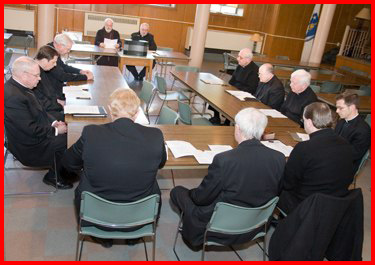
On Thursday, we had a meeting with the auxiliary bishops and the vicars from throughout the archdiocese. The vicars forane are priests who have responsibility in their area to help promote the priestly life and to work with the auxiliary bishops. They have a leadership role in their local communities

We have periodic meetings with them. Yesterday was a very productive meeting. We talked about the need for parish collaboration in the various areas of the archdiocese. They shared with us information about what is happening in their regions. Each of the vicars is responsible for calling a monthly meeting of the priests in their area. In those meetings they discuss the themes that are being discussed at the Presbyteral Council, so it�s a way of allowing the priests out at the parishes to have a voice and input into the central administration of the archdiocese. The vicars have an important role in that whole system of communications.
bishopsvicars.jpg

The bishops and vicars meeting

We are anxious to strengthen the role of the auxiliary bishops and the regional structure of the archdiocese. In fact, there is a new cabinet member for the regions, Sister Marian Batho.
bishopsvicars_img_0639.jpg

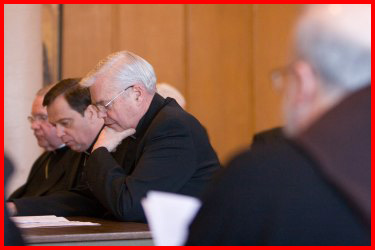
Bishops Dooher, Hennessey and Edyvean

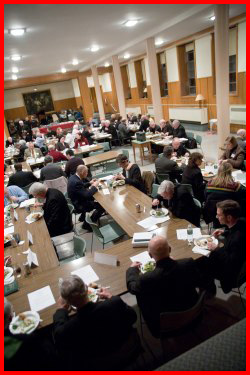
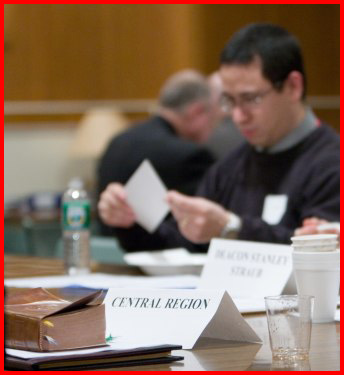
The meeting was extended so the vicars could meet with the members of the Archdiocesan Pastoral Council (APC). We had the council members break up by regions with their auxiliary bishops so they could discuss how the APC could be more plugged in to their regional structure.
apc__img_0684.jpg

At the APC we were seated around U-shaped tables, by region
apc__img_0660.jpg

apc__img_0679.jpg

There were many fruitful discussions

Then we had a long discussion on the celebrations of the archdiocesan bicentennial. Father Bob Connors and other members of the bicentennial committee gave us a fine presentation on the bicentennial observances.

After the report on the bicentennial, the meeting continued just with the members of the APC. At that point it was information sharing and everyone who has a particular idea or a suggestion can address it to myself or the vicar general. It is always a very valuable part of the meeting.

This Saturday I will preside the Mass of ordination of seven transitional deacons, who will be ordained to the priesthood in May. Pray for them, and I look forward to sharing that joyous event with you in next week�s post.

Yours in Christ,

Cardinal Se�n

Remembering Martin Luther King Jr.

Good afternoon and welcome to my blog. If you are regular readers or visiting for the first time, I hope you enjoy reading the blog and viewing the pictures from this week’s activities.

On Sunday, I traveled to St. Joseph Parish in Lynn for the celebration of “el Santo Cristo Negro de Esquipulas.” Esquipulas is a town in Guatemala, and at the Benedictine abbey there is a very ancient crucifix made 500 years ago.

lynn3.jpg

This image of Christ was made by a Portuguese immigrant for the community there, and it’s carved in black wood — Central America is famous for its precious woods. The crucifix is a great object of devotion and has been a great source of pilgrimages. Miracles have been attributed to the prayers of visitors who pray in front of the image.

The parish community at St. Joseph’s serves many new immigrants from different Latin American countries as well as its English-speaking community. The Guatemalan community and the Dominican communities are the two larger groups in the parish.

The Mass for “el Santo Cristo Negro de Esquipulas” was a beautiful celebration. They had wonderful choirs singing, and many of the Guatemalans were in their native costumes. Guatemala is the country in the hemisphere that has the largest percentage of indigenous people. Unlike many of the indigenous peoples in the Americas, the Guatemalans have preserved their languages and their customs.

lynn4.jpg

lynn25.jpg

The headdress is typical of the Guatemalan traditional dress.

lynn18.jpg

lynn24.jpg

And these women here are all in typical garb

lynn20.jpg

There were also many children present.
The pastor at St. Joseph’s, Father Jim Gaudreau has a very active outreach and evangelization. He’s a man of such great dedications and has shown great pastoral care of Hispanic immigrants. He has a very creative and zealous way of reaching out to the people. He said over 500 people are taking Bible classes at the parish.

lynn5.jpg

Father Jim Gaudreau

There is also a large Brazilian community in the parish and a wonderful group of sisters from Mexico, las Hermanas Misioneras Servidoras de la Palabra, who are doing good work at several parishes in the archdiocese, including St. Joseph’s. They train many people to do home visitations and focus on adult faith education, which is very important.

lynn21.jpg

There were several key supporters of the parish present
who where given plaques of recognition.

- – -

Also on Sunday I took part in the annual assembly for the Massachusetts Citizens for Life held in Boston’s historic Faneuil Hall. Attorney Phil Moran delivered the keynote address. He gave a fine presentation on the pro-life issue in our present circumstances. Several others spoke as well including Ambassador Ray Flynn, MCFL president Joseph Reilly, executive director Marie Sturgis and board members Father David Mullen and Mildred Jefferson also spoke.

mcfl07_img_0123-copy.jpg

Phil Moran

mcfl07_img_0155.jpg

Dr. Mildred Jefferson

I addressed the crowd as well and thanked the MCFL and all those who have participated in the great work they do. Every year they have organized a rally in October that is an important way for the local community to mark pro-life month, and we’re grateful for that. We know that they’ve had struggles, but their new capital campaign is a moment for them to reaffirm their mission and it is an important way for the Catholic community to work with other churches as well as secular organizations who stand together in favor of life. I ended my comments with the peace prayer of St. Francis and a blessing.

mcfl07_img_9630.jpg

My address to the assembly

- – -

Later on that evening, we had a vespers ceremony at St. John’s Seminary in memory of Martin Luther King, Jr. The Archdiocese of Boston Black Catholic Choir did a magnificent job. Pierre Monette presented a dramatic reading of Martin Luther King’s “I Been to the Mountaintop” speech, which was superb. Everyone was very moved. He did it in a very passionate way and very convincingly. Lorna DesRoses coordinator of Black Catholic Ministry in the Office of Cultural Diversity did an excellent job putting together a wonderful evening of prayer and song.

mlk2.jpg

The Black Catholic Choir performing

The talk that I gave at the event was based on a Pastoral Letter on Racism, “Solidarity: Arduous Journey to the ‘Promised Land’” I wrote in the year 2000 while Bishop of Fall River.

I’d like to share that text with you:

Jesus’ ministry is a clear manifestation of the universal love of the Father; for beyond His ministry to the Chosen People of Israel, Jesus reaches out to the pagans, curing the centurion’s servant. The daughter of the Syro-Phoenician woman, as well as the possessed Gerasene man in the Decapolis, are also beneficiaries of the Lord’s healing power. The Apostles themselves are surprised to find the Lord talking to the Samaritan woman at the well and certainly disconcerted by His bold assertion that many would come from the east and the west and would sit down at table with Abraham, Isaac and Jacob when God’s kingdom is realized.

The irresistible logic of Christ’s teaching allows the Church to be truly Catholic, and to embrace the universalizing implications of the Gospel message. Paul, the Apostle of the Gentiles, saw the breaking down of the wall of hostility between Jew and Gentile as one of the great watersheds in the history of salvation. The Church proclaims our God who shows no partiality except, perhaps, for the margin-alized and excluded. St. James warns us about being “partial towards persons,” about discriminating against those who are poor, or different in favor of the rich and famous. St. James, in his epistle admonishes us:

“My brothers, as believers in our Lord Jesus Christ, the Lord of Glory, you must never treat people in different ways according to their outward appearances” (James 2:1). The Sacred writer goes on to condemn this discrimination: “you are guilty of creating distinctions among yourselves and of making judgments based on evil motives” (James 2:4).

The teaching of Christ is unambiguous that the whole of our religion, “the Law and the Prophets” is based on the Great Commandment of Love. No matter how outstanding our talents or contributions, “if I have not love, I am nothing” (1 Cor 13:2). If we claim that we love God but hate our neighbor, then we are “a Liar”; for “one cannot love God whom he has not seen, if he does not love his brother, whom he has seen” (1 John 4:20).

When asked for a definition of neighbor, our Lord answers with the parable of the Good Samaritan. Jesus astonished his audience by making the Samaritan, the member of a despised minority group, the hero and protagonist of the story. In one fell swoop Jesus pops the bubble of ethnic superiority and at the same time challenges us to be a neighbor to all in need and to remove the barriers in our heart that prevent us from seeing our connectedness with every human being. For when Jesus says neighbor, He is talking about a big neighborhood: first of all anyone who is in need and has a claim on our help, as well as every man, woman and child of whatever religious persuasion, social status, ethnic or linguistic background, liberal or conservative, heterosexual or homosexual, Democrat or Republican, old or young, and all of the above, in all shades, colors and sizes. There is absolutely no room for racism and discrimination in Jesus’ concept of neighbor.

We can truly love God only when we truly love our neighbor, made in His image and likeness. Apart from that love, there is no authentic religion. Because love is the essence of our religion, racism is a dangerous heresy that subverts the announcing of the Gospel.

The history of our country has been deeply marked by the sin of racism, which is a betrayal of our Christian faith as well as our democratic ideals. Despite great progress in the area of civil rights since the murder of Dr. Martin Luther King Jr., his dream of racial harmony is still a dream deferred. The “promised land” of integration where “children of former slaves and children of former slaveholders could sit down at the table of brotherhood,” so much more difficult than desegregation, is still very elusive. Church burnings and other hate crimes continue, and motorists are still stopped for “driving while black.” In the last year, 220 articles on racial violence appeared on the pages of The New York Times including the tragic high profile accounts of the torture of Abner Louima and the killing of Amadou Diallo.

It is with shame and sorrow that we recall the plight of Native Americans and Blacks, the two groups to suffer the most devastating effects of the sin of racism in our country. It is obvious that racism in all its forms and disguises is a dehumanizing force that demeans its victims and renders its perpetrators diminished in their humanity, or to use an expression of Pope Paul VI, “mutilated by their selfishness.”

The racial tensions in the U.S. find a counterpart in the ethnic and nationalistic violence abroad. In fact, of the 50 million people who have died in armed conflicts since the end of World War II, most have perished in “ethnic” conflicts — in Rwanda, Burundi, Angola, Mozambique, India, Pakistan, Bangladesh, East Timor and the former Yugoslavia. The dawn of the new millennium finds the whole world struggling with a legacy of devastating racial and ethnic violence.

The challenge for believers is to build a civilization of love in a world where there is so much division. The ministry of reconciliation is a sacred duty of Christ’s Church. Diversity must be seen as something that can enrich the human family. We must move from fear and suspicion to tolerance and from tolerance to solidarity. This is not a utopian quest but a moral imperative for peace and progress on our planet. Indeed, it is probably a question of survival. There will be a civilization of love or no civilization at all.

To combat racism at its root, we must begin with a personal inventory, an examination of conscience and a profound realization of how pernicious racism is. Racial bias profoundly affects our culture. It deforms relationships within and between racial or ethnic groups. It undermines the possibility of true community. In addition, racial bigotry exacerbates unhealthy competition, destroys people’s self-confidence and initiative. This sin prevents us from being what God has called us to be.

Racism has many faces, not just a pointed hood of the white supremacists. It is evidenced in one’s tendency to stereotype people, in an extreme pride in one’s own country or race, in belittling members of other races, in condescending attitudes or behavior, and in not taking peoples of other races seriously. A racist attitude finds expression in a lack of impartiality, in the failure to recognize the negative impact of racism on the victim, by encouraging prejudice in others and laughing at racist jokes that are hurtful and demeaning.

In the Parable of Lazarus and Dives, the rich man goes to Hades, not for adultery, or murder, or robbery, but because he was incapable of seeing Lazarus suffering at his doorstep. In a similar fashion, racism makes one blind to the presence of persons of other races. They become like nameless pieces of furniture that clutter up the landscape. Racism will be banished when we overcome our blindness to the people around us; and when instead of being blind, we become color blind, indifferent to people’s complexion, but not to their dignity and their feelings.

Desegregation was the process which eliminated discriminatory laws and barriers to full participation in American life. Integration is much more difficult to achieve because it demands a change of heart. Desegregation may unlock doors, but integration is when minds and hearts are opened as well, when the welcome mat is placed at the door.

Integration is so compelling because it is about people, not laws. It is about the way we see each other and treat others, it is about whether there will be room in our hearts and homes and classrooms and clubs and churches to welcome each other naturally as neighbors and friends. Desegregation is about laws; integration is about the Golden Rule.

In the play “South Pacific,” Rodgers and Hammerstein have a song that goes: “You have to be taught to hate and fear. You have to be taught from year to year. It has to be drummed into your little ear. You have to be carefully taught.”

Racism is like a disease most often transmitted from parent to child. Its early symptom is the delusion that one’s race is somehow superior to others. In advanced stages, it leads to hatred, violence, and untold suffering. This contagion needs to be checked. The 20th century was able to entirely eliminate certain diseases like small pox and polio, but this spiritual disease of racism is still menacing our world as we begin a new millennium.

In the fight against any disease it is necessary to recognize the threat. Too often we are in denial about racism. The reality has been driven underground. Because cruder historic forms of racist sentiments and behavior are considered “politically incorrect,” and because more laws have been passed, more “concessions” made, there is a false sense of security that the problem has been dealt with. But too often the spiritual problem has not been dealt with: repentance, change of heart, forgiveness, respect are still needed. Today’s racism is more subtle but no less real. As the United States Catholic Conference Document, “Brothers and Sisters to Us,” asserts racism, “is manifest also in the indifference that replaces open hatred. The minority poor are seen as the dross of a post-industrial society — without skills, without motivation, without incentive. They are expendable. Many times, the new face of racism is the computer printout, the pink slip, the nameless statistic. Today’s racism flourishes in the triumph of private concern over public responsibility, individual success over social commitment, and personal fulfillment over authentic compassion” (B.S.T.U. 1997, p. 6).

In Catholic social teaching, the antidote for racism is Solidarity. It is a concept used by Paul VI in “Populorum Progressio” in his discussion of development. Pope John Paul II expands on this virtue in his Encyclical letter “Sollicitudo Rei Socialis”: “In the light of faith, solidarity seeks to go beyond itself, to take on the specifically Christian dimensions of total gratuity, forgiveness and reconciliation. One’s neighbor is then not only a human being with his or her own rights and a fundamental equality with everyone else, but becomes the living image of God the Father, redeemed by the blood of Jesus Christ and placed under the permanent action of the Holy Spirit. One’s neighbor must therefore be loved, even if an enemy, with the same love with which the Lord loves him or her; and for that person’s sake one must be ready for sacrifice, even the ultimate one: to lay down one’s life for the brethren” (S.R.S. #40).

Solidarity is an expression of the great commandment that calls us to form a community among people that will enable us to overcome “structures of sin and oppression” that dog humanity. Above the human and natural bonds already so strong, faith leads us to see “a new model of the unity of the human race.” The Holy Father insists that Solidarity is not sentimentality or a vague compassion or empathy for the suffering of so many, but rather it is a firm and persevering determination to commit oneself to the common good, that is to say the good of all and of each individual, “because we are all really responsible for all” (SRS #38).

We must embrace the concept of solidarity as a solution to racism, as well as to the greed and the competition that has fractionalized our country and our planet. Solidarity is the virtue we need to instill in the new generation so that racism might become a sad anachronism in our lifetime. Just as racism is contagious, so too solidarity can inspire our young people when they see the witness of men and women committed to social justice and the good of the entire community.

As we campaign against cigarettes and drugs, we must also launch a campaign of zero tolerance for the intolerance of racism. Parents and teachers need to be the protagonists of this effort. Each of us ought to begin with our own personal conversion and testimony. We also need to create opportunities and space for friendship with people who are of different races and ethnic backgrounds. As a community we should celebrate the gifts and the traditions of all “our neighbors” and work together to build a better community where people care about each other.

Racism thrives on fear, but love casts out fear. Solidarity transforms relationships and connects us with each other. Fear and suspicion are changed into a sense of partnership in a community that truly recognizes the value of each and every person as irreplaceable and as precious in the eyes of God.

The virtue of solidarity is not only an antidote to our racial tensions in our own country, but points the way to a program of development and world peace based on a “new model of the unity of the human race.” In his message for World Peace Day, Pope John Paul II states: “… we can set forth one certain principle: there will be peace only to the extent that humanity as a whole rediscovers its fundamental call to be one family, a family in which the dignity and rights of individuals, whatever their status, race or religion, are accepted as prior and superior to any kind of difference or distinction” (World Day of Peace #5).

Given the U.S. economic, cultural and military power, the Holy Father’s dream of humanity becoming “a single family built on the values of justice, equity and solidarity” is in some ways contingent on the ability of Americans of good will being able to bring about Dr. Martin Luther King Jr.’s dream of the “Promised Land” of racial integration in our corner of the globe. Our quest is to become what God has called us to be.

- – -

The archdiocesan offices were closed on Martin Luther King Day, and I took advantage of that to visit our novitiate in Pittsburgh. I had not been there for a few years and the friars have been encouraging me to come. It was an opportunity to be with the novices and speak with them. The evening that I was there, they had a Mass for a third order group. The lay people came in, had a Mass and visited with the novices. It was a very nice event.

Here’s a picture with all the friars in the chapel:

img_1917.jpg

There are about a dozen novices right now and about 30 members of the community.

There are two beautiful windows in the novitiate, depicting St. Francis — one of him building the Church and the other of when he gives his clothes back to his father.

img_1934.jpg img_1930.jpg


There’s also a statue of St. Conrad in the novitiate. St. Conrad, the patron of the novitiate, was a Capuchin lay brother from Germany.

img_1929.jpg

img_1925.jpg

This statue of Our Lady of Altoetting,
patroness of Bavaria, is also in the novitiate

St. Conrad was a member of the German province of the Capuchins, that I joined in Pennsylvania. The Capuchins established the community of St. Augustine in Pennsylvania to minister to the large German immigrant population. St. Conrad used to serve Mass for the first rector of the seminary where I studied. St. Conrad was a porter at a very famous Marian shrine in Germany called Altoetting. He lived between 1818 and 1894.

altotting_img_7985.jpg

Some photos of the Shrine of Altoetting

altotting_img_7907.jpg

altotting_img_7902.jpg

The interior of the Church of St. Conrad in Altoetting

altotting_img_7938.jpg

The reliquary of saint can be seen under the altar
altotting_img_7970.jpg
St. Conrad would use this small door to speak
with those who rang the doorbell of the Capuchin monastery

In fact, the last time the Holy Father was in Germany, he visited his grave. St. Conrad is the only German canonized from the time of the Reformation until modern times when John Paul II canonized some Germans. He was, as I said, a porter, lay brother at this very important Marian shrine.

The novitiate was a wonderful time in my life, and I was happy to be with the novices who were so filled with joy and enthusiasm for their vocations. It took me back to my novitiate, which was in 1964. In those days we went to college for two years  at  St. Fidelis in Pennsylvania  and then we went to novitiate in Annapolis Maryland. After the novitiate, we went back to Pennsylvania to study Philosophy . Then I went to Washington D.C. to study theology.

The statue of St. Conrad, the same crucifix and a lot of other religious symbols which are currently in Pennsylvania used to be in Annapolis.

img_1922.jpg

The crucifix

Also visiting the novitiate was one of the priests who I was in the seminary with, Father Bill Fay. He was home visiting his mother. He is now teaching at our national seminary in Port Moresby, the capital of Papua New Guinea. Previously he taught at Oxford University. He’s a very accomplished theologian, and he has also taught at our seminaries in Africa.

img_1907.jpg

Celebrating Mass with the community

img_1906.jpg

Some photos with the novices

img_1905.jpg

- – -

This weekend I will be heading to Washington D.C. for the March for Life on Monday. I’m very happy that there will be a number of buses going down from the Archdiocese of Boston. Many parishes, Catholic high schools and the Vocations Office will be sending buses. The march is always a wonderful event. It’s an opportunity for young people to experience the universal Church and to be a part of this very important campaign on behalf of the dignity of human life. We participate in this campaign as believers, and it’s part of our commitment to discipleship.

I urge all of you to pray for an increased respect for life in our culture and the whole world. Even if you are not able to travel to Washington, you can send your prayers with all those who are able to go.

For the photo of week, I’d like to share this photo of the sun setting behind a statue of Our Blessed Mother in Altoetting.

virgin_img_7975.jpg

Yours in Christ,

Cardinal Seán