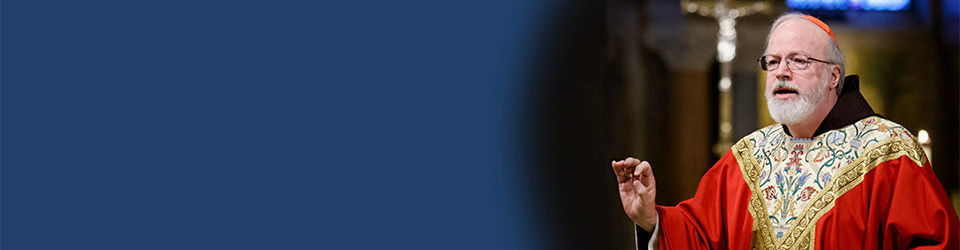
Greetings everyone and thank you for the comments you send to my blog. I wish you all a blessed Season of Lent.
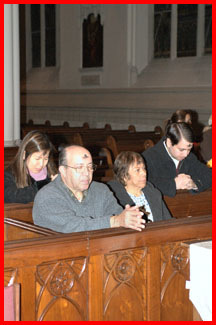
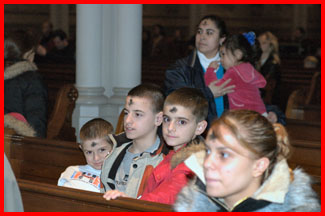
For Catholics, Lent is a very important time which, of course, begins with Ash Wednesday. I am always amazed at how Ash Wednesday seems to capture people�s imaginations and their desire to connect with the Church. So many people mark this moment by participating in the distribution of ashes.
On Ash Wednesday, I celebrated Mass at St. Francis Chapel in the Prudential Center. The chapel is located in the middle of a shopping center. The crowd at the Mass was full of young people � professionals, shoppers and students. It was wonderful to see that there was standing-room only. They had already had four Masses and they were going to have another three!
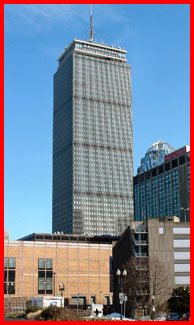
The chapel is located inside the
Prudential Center in Boston’s Back Bay neighborhood
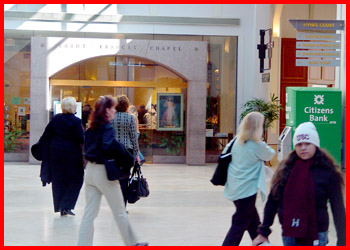
St. Francis Chapel
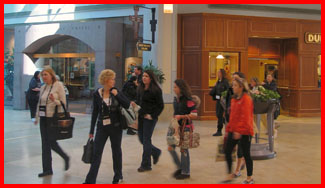
As you can see, the chapel is located inside a bustling mall
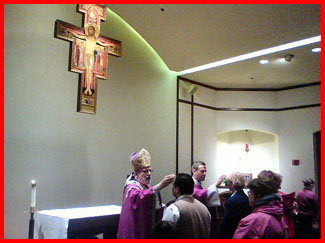
Distributing ashes at St. Francis Chapel
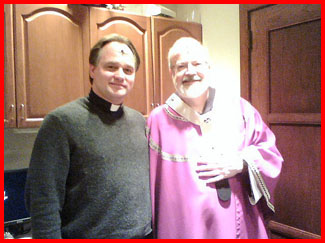
Father David Yankauskas, OMV
Ash Wednesday services are a very important moment in the life of the Church because the call to conversion is sounded through the liturgy. It is a time when people are most inclined to take their spiritual life seriously. Certainly, the penitential practices are all very, very important and I would certainly encourage people to try to spend time in spiritual reading this Lent, particularly reading from the Gospels in the New Testament, which are the basis for our Christian life.
Ash Wednesday services bring great crowds throughout the Archdiocese of Boston. We also had a large group at the Cathedral of the Holy Cross on Wednesday evening where I celebrated a bilingual Mass.
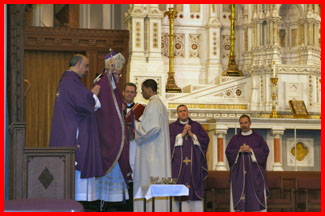
Blessing the ashes
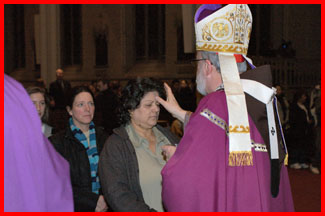
�Remember you are dust, and to dust you shall return�
I also want to share with you my Lenten letter, published in this week�s Pilot:
Dearly Beloved in Christ,
Lent always begins with the powerful symbol of ashes. I love to see people walking down the street with the smudge on their foreheads. I feel a sense of solidarity with fellow believers who are saying to the world: �I believe in God who created me. I am a sinner doomed to die, but in God�s love Jesus Christ stepped in front of the bullet to save me. And I am a Catholic. And Lent is here.� A little bit of ashes says so much.
One of my favorite stories from the Bible is the story of Jonah who was a reluctant prophet. He was afraid to deliver the bad news to the people of Nineveh: �In 40 days God is going to destroy your city because you are all so wicked.� The king and the people put ashes on their heads, fasted and prayed and the story has a happy ending. God says, �I forgive you. I shall spare your city.� I am always amused by the fact that Jonah was disappointed by the outcome. He had been looking forward to the fireworks. God however is always working for a happy ending. The ashes remind us that we come from dust, and it is a round trip. But the ashes are placed in the shape of a cross. The dust has been redeemed! God so loved the world that He sent us Jesus as our Savior.
Religion and jogging are seen in our pluralistic society as optional extras. Even the churches seem not to question this assumption. Much energy is expended demonstrating that religion is a desirable �optional extra.� So religion becomes a product to be sold, just one of many pathways to individual fulfillment.
But in fact, we are made with an orientation toward God. We are made for God. The ashes on our foreheads should be a sign to all of the urgency of the Gospel. We are the Ninevites and our story will have a happy ending only if we take the Word of God seriously.
Sometimes we want to follow Jesus at a safe distance, like Peter on Holy Thursday after Jesus is arrested. Sometimes we want to be invisible Christians blending into the landscape. Yet Jesus reminds us that: �You are the light of the world, a city built on a hill cannot be hidden� (Matt 5:14). Dietrich Bonhoeffer said that discipleship is as visible as light in the dark, as a mountain in the flatland.
The Sermon on the Mount begins with Jesus gathering His disciples around Him to teach them. The Sermon on the Mount and the Beatitudes are not a list of requirements but a description of the life of a people gathered around Jesus.
Lent is a time to circle the wagons, to live more intensely our union with the Lord and with our brothers and sisters in the Church. I would certainly encourage participation in the Men�s and Women�s Conferences on March 17 and 18 as a joyful Lenten experience. To reduce Lent to a 40-day long crash diet or exercise program is to miss the boat. Discipline is a part of Lent, but only in the context of penance, which means �conversion of heart.� Fasting, almsgiving, mortifications are not themselves �penance� but rather the fruits of penance.
The visibility that Jesus calls for in the first part of the Sermon on the Mount is qualified by His rebuke of those who practice righteousness in order to be seen. We are to be the light of the world, but we are to give alms in secret.
Jesus� admonition that we avoid calling attention to ourselves through practice of piety implies that not only is it important what we do but also how we do it. Our external actions take on value in God�s eyes when they reflect the love and humility in our heart. Our focus must not be on our good deeds but in following Jesus and in being gathered with the other disciples around Jesus.
Prayer helps us shift the focus from us to God and to deepen our awareness that any capacity to do good works is itself a gift from God. We do not congratulate ourselves for good works, but rather we thank God that despite our sinfulness and limitations, God can make His Goodness shine through our actions. Virtue is not to be understood simply as what we do but rather what has been made possible by the gifts we have received.
The only true success that guarantees the happy ending is a life of discipleship where we manage to make a gift of ourselves to God and to others. Lent should help us in the process. Prayer, works of mercy, Mass and confession are all part of the formula for a good Lent.
As the fattest people on the planet and people most addicted to entertainment, a little mortification is in order. It is a way we say to God that we are sorry for our sins, and it is an opportunity to experience in some small way the hunger and deprivation of so many of our brothers and sisters. The money we save also affords us the possibility of giving alms to help relieve the hunger and misery in our world.
So, we begin our 40 days with the people of Nineveh and ashes on our forehead. We accompany Jesus who fasted and prayed for 40 days, and we join the 150,000 adults who are preparing to be received into the Catholic Church in the United States on Holy Saturday at the Easter Vigil. For all of us, Lent is a Baptismal Retreat and at Easter we will solemnly renew our baptismal promises. Lent is an important part of our spiritual journey. Now is the time to get on board.
I shared this letter with those attending the bilingual Mass at the cathedral. I added the following in Spanish:
Hay una leyenda que habla de un pordiosero que estaba pidiendo limosna al borde del camino. En el horizonte vio aproximarse un pr�ncipe en una carroza dorada. El se entusiasm� pensando que iba a recibir una gran limosna. El pr�ncipe se detuvo, pero se qued� muy sorprendido cuand� vio al pr�ncipe bajar de la carroza y, en vez de darle limosna, extender su mano pidi�ndole algo. El mendigo rebusc� en su bolsillo donde ten�a las cosas que hab�a ido recibiendo ese d�a. Sac� un granito de ma�z y lo puso en la mano del pr�ncipe. El pr�ncipe subi� en la carroza y se fue. Esa noche, cuando el mendigo vaci� sus bolsillos, llenos de lo que hab�a recibido ese d�a, hall� entre las cosas una pepita de oro. Y �l pens� y dijo,. �Si lo hubiera dado todo! La Cuaresma es un momento para dar nuestro �todo� al Se�or. Las cenizas que vamos a llevar en nuestra frente recuerdan que la vida es un poco de tiempo, y al crep�sculo vamos a descubrir el tesoro que nos espera, o el vac�o. Todo depende de c�mo vivimos nuestras vidas. Si damos nuestro �todo,� imitando as� la entrega total de Jes�s. La Cuaresma es un despertador, una alarma para espabilarnos y encaminarnos hacia nuestra meta que es el Reino de Dios.
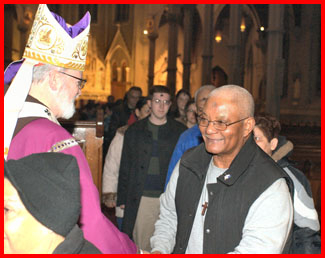
Greeting worshipers following the Mass
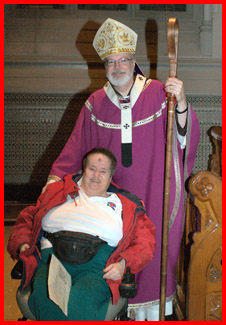
Helen Hurley,
a resident of Cathedral Parish
I want to reiterate our invitation to participate in the Men�s and the Women�s Conferences that are coming up on March 17 and 18, respectively. They will be held at the Boston Convention and Exhibition Center in South Boston. We know that the conferences have been a special moment of grace for all of those who participated in the past. Last year we had over 50 priests hearing confessions for hours. People received so much from the conferences and from the experience of being with fellow believers and feeling the support of the testimony of the faith of so many men and women. It is a very unique opportunity for Lent. I hope many will take advantage of it.
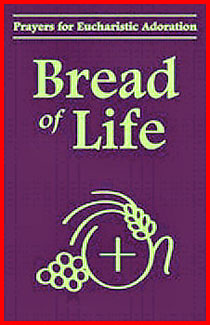
Usually before Lent I send a letter to the priests inviting them to prepare their own rule of life because the danger is that we who are ministering can become so caught up in the activities and services that we are giving to the people that we can lose sight of our own need to make time and space for God. Making that time will make our own Lent a time of renewal and a deepening of our relationship with the Lord. With the letter I also sent a book for them to read this Lent. It is a lovely book entitled �The Bread of Life� published by the Daughters of St. Paul . It contains many prayers, devotions and meditations on the Mass and the Blessed Sacrament.
– – –
Since my last post , I attended to two social functions with the priests � one with the priests in the south region and the other with alumni priests from Boston College High School. In the south region, Father Kelly and Deacon Pat Guerrini organized an opportunity for the priests to come together at St. James Parish in Stoughton. Likewise, the Jesuits at Boston College invited the alumni, including Bishop Hennessey, to meet. The Jesuit community at BC has been inviting the priests for many years as a pre-Lenten activity, and the priests are very appreciative. Both meetings are important opportunities for priestly fraternity. They are gatherings that are opportunities to get to know the priests, share with them and enjoy their company.
– – –
On Friday I traveled to the Elmbrook Student Center in Cambridge, an Opus Dei residence for students near Harvard University. I was there for a Holy Hour with them. We also had dinner, a conversation about spiritual topics with the students and a performance by the students where they sang and played musical instruments.
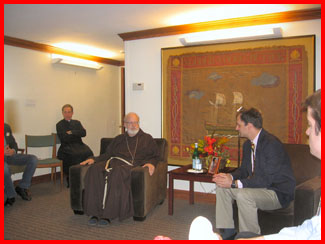
It was an inspiring conversation
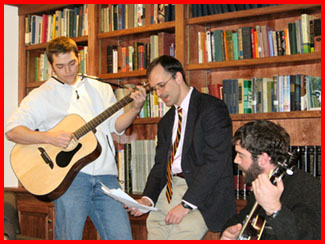
They did a great job with the music
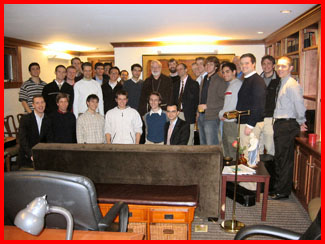
Opus Dei has worked in the Cambridge area for many years and has been a spiritual oasis for students and young professionals. Elmbrook provides them with the opportunity to receive a spiritual formation and to celebrate the sacraments. I think it complements the very good campus ministry that is based out of St. Paul Parish where I will be going April 10 to celebrate Mass at the Harvard Catholic Student Center.
– – –
I celebrated Mass for the Masters of Arts in Ministry Program on Saturday. The program has a couple of retreat days each year, including this winter retreat. Students, some graduates and some people interested in the program attend. The day-long gathering takes place in a beautiful chapel at the Campion Renewal Center in Weston. It was a lovely setting. After Mass, we had a question and answer period, and we talked about ministry and the challenges of lay ministry in the archdiocese and in the Church in general. We all recognized that the need for lay ministry is always growing in the Church, and in the future it will take on even greater importance.
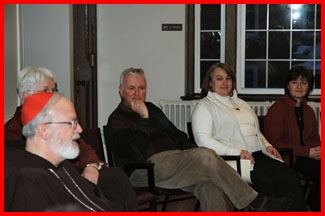
Speaking about the challenges of lay ministry
Sister Mary Pierre Jean Wilson, Aldona Lingertat and the others who run the program are very dedicated. They stress not only the intellectual formation of the students but also building a sense of community among them and helping them to cultivate an interior life that will allow them to have spiritual resources. These spiritual resources must complement the intellectual and theological training for ministry in the Church. This retreat is just one more way they try to attend to the spiritual needs of their students.
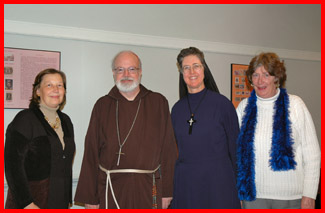
From left to right, Aldona Lingertat, MAM’s associate director,
Sr. M. Pierre Jean, R.S.M., director and Maryellen Lenihan, secretary.
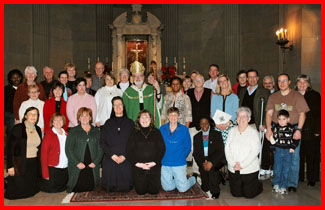
The group participating in the retreat
– – –
The Charismatic Renewal had a two-day conference in Lynn, and I joined them for Mass on Sunday. They were celebrating the 40th anniversary of the beginning of the charismatic movement, which began at Duquesne University in Pittsburgh in 1967. Many of the local prayer groups were there. In all, 1,000 were in attendance, many of them young people.
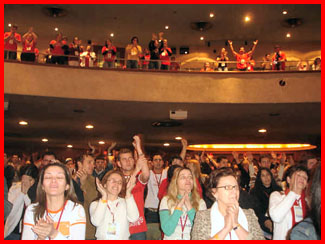
A thousand people attended the conference
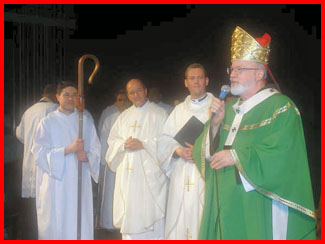
Greeting the participants
It was not specifically a Brazilian event, but I estimate that nearly 80 percent of the participants were Brazilian and most of the Mass was in Portuguese. The Charismatic Renewal has given many of our immigrants a sense of community, of belonging and that is very important. Many of them had experienced charismatic communities in their own countries. Joining a such a community here is a way for them to find a spiritual home in our archdiocese. I am grateful to the leaders and the priests who minister to them and help these communities to thrive.
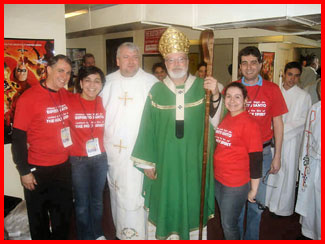
Some enthusiastic members of the Charismatic Renewal
and Father Claudio Peters who coordinated the event
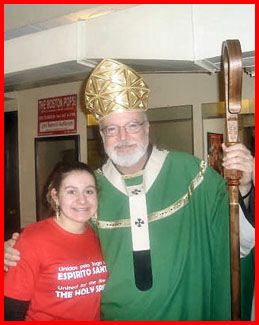
It was nice to be able to spend some
time meeting people following the celebration
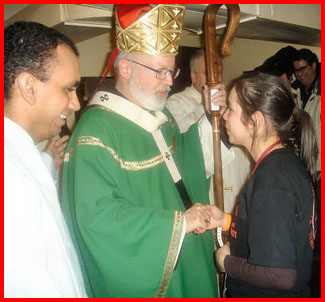
The charismatic movement in the Church has been a great source of spiritual renewal for many people. It has helped many to develop a deep appreciation for the scripture, for a life of prayer and for the role of the Holy Spirit in our lives, both individually and communally in the Church. The Mass was characterized by the joy and the uplifting music. That music is something the charismatic movement promotes, particularly in the Brazilian community.
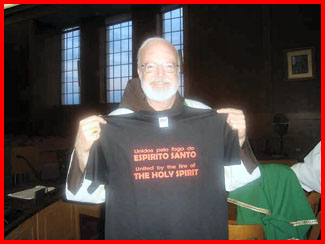
It reads: United by the fire of the Holy Spirit.
Amen to that!
– – –
Thursday night I had a meeting with the Deacon Community Board. As the priests and the diocesan pastoral council meet periodically with the cardinal, so too do the permanent deacons. The Board has representatives from all the regions and its role is to share with me their concerns, aspirations and plans of the diaconal community. Deacon Leo Donoghue, director of the Office of the Permanent Diaconate, is always present and Father Bill Kelly from the Office of Clergy Support is also part of the Board.
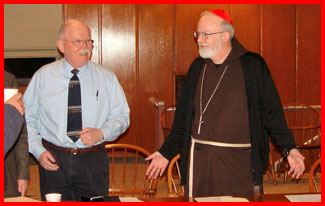
Sharing a light moment with Deacon Leo Donoghue
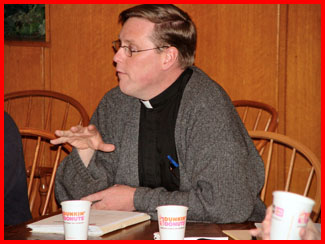
Father Bill Kelly
It is always very uplifting to be in touch with our deacons. We currently have 246 permanent deacons Their ministry is very important in our archdiocese. The deacons have the special role in fermenting unity in the Church. The Holy Spirit guided the Church to form the diaconate to help to bridge differences and to bring about unity among God�s people. I am also very grateful for the support they receive from their wives, who share in the ministry of their husbands.
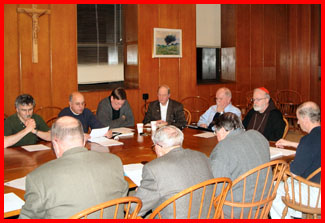
The meeting began with a time of prayer
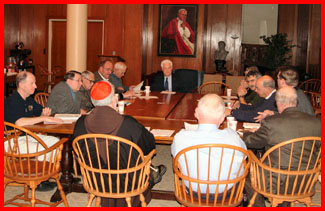
During the discussions
– – –
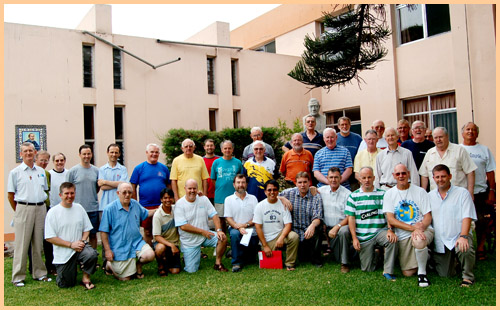
Finally, the following two photos from my visit to the St. James Society in Peru did not arrive on time for my last week�s posting. The priest who took them was back in his parish in the mountains � La Sierra � and had no way to send them to Boston until he returned to Lima.
In the first photo, I am pictured with�the four new members of the Society of St. James. Msgr. Finbar O’Leary,�director of the Society, is at my left in the photo.
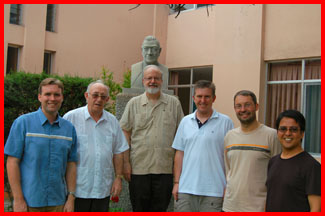
As my photo of the week, I’ve chosen this group photo of the priests of the Society of St. James taken just a few days ago who are currently serving the poorest among the poor in Peru, Bolivia and Ecuador. Please pray for them and for their ministries.