Cardinal Seán's Blog

Cardinal Seán shares his reflections & experiences.

Archive for 2007/03


Holy week is around the corner

Welcome all to my weekly blog post!

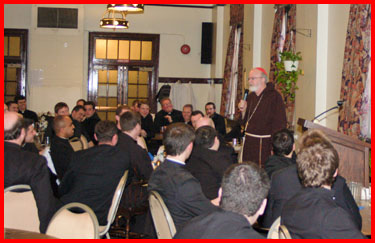
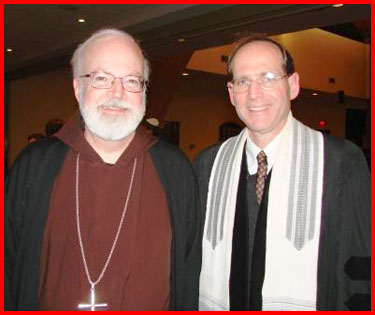
Last Friday, I had the opportunity to speak at Temple Emanuel in Andover. Rabbi Robert Goldstein couldn’t have been a more gracious host. The Jewish community had invited me sometime ago to speak at one of their regular Sabbath services. As it turned out, it was the day after the Anti-Defamation League’s “Nation of Immigrants” Community Seder meal. This was merely by happenstance because these things are planned so far in advance.
024.jpg

Rabbi Goldstein and I

It was the first time that I’ve spoken in a synagogue in Boston. I had been invited to speak in synagogues in other dioceses, and I was happy to have my first opportunity to do it here. There was a very large congregation present — also many Catholics came to be a part of the celebration, which was nice. It was an opportunity to bring Catholics and Jews together. Many of the priests in the area and the friars from Merrimack College have come to know the rabbi and were a part of the celebration.

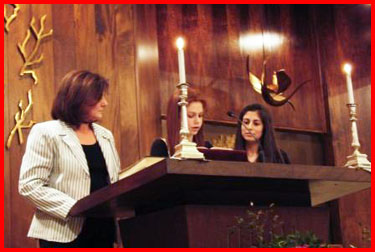
One young lady in the congregation, by the name of Morgan, was preparing for her Bat Mitzvah so she did some chanting of the Scripture. She had great poise and I’m sure that when that she was originally scheduled she had no idea there were going to be so many visitors in her synagogue! But she did it very well.
044.jpg

Morgan chants the Scripture

The music at the service was beautiful. They had many instruments accompanying a youth choir.

Among the congregants there are Victoria Block and Steve Cooper, reporters from Channel 7. They were at the service and I had an opportunity to speak with them both.

It’s important for us as Catholics to cultivate these friendships with the Jewish community and to work to achieve greater understanding and cooperation.

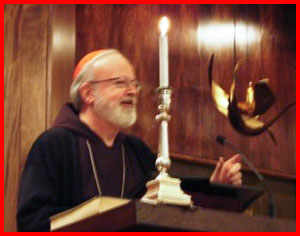
In my remarks to them I spoke of the influence of the Jewish traditions on our Catholic faith.
015.jpg

Delivering my remarks

I began speaking about the holiness of the Sabbath: how in the Catholic tradition we have the Lord’s Day, which for us is the Sabbath, and that we share the same concept of giving a time to God and to rest. I also spoke about the Ten Commandments, the Psalms, the Scriptures, and of course the fact that Jesus and Mary, the Apostles and the first Christians were all Jews. I went on to explain how the Mass — which is the most sacred thing that we have and the center of our lives — is very much tied to the Jewish experience. The liturgy of the Word is very much based on the synagogue service, and the liturgy of the Eucharist coming out of Jesus’s celebration of the Seder meal which he makes the context of giving us the Eucharist.
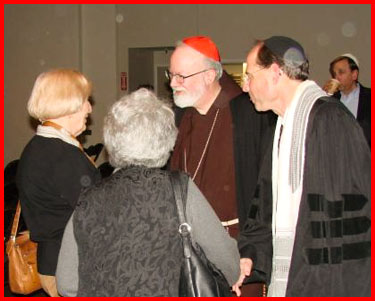
036.jpg

I had a chance to meet many members of the congregation

I also mentioned the mezzuzah the Jewish community gave me in Fall River when I left that community, and I spoke about the relationship I had with them.

Of course, I still have that mezzuzah, though I haven’t put it up in the cathedral rectory yet. I did, however, have it on my door in Palm Beach. There was such a large Jewish population there that many people immediately knew what it was. My guess is that won’t be the always case with many of the Irish Catholics here in Boston!

- – -

On Saturday, I joined the permanent deacons of the archdiocese for their annual convocation. Father John Gordon from Steubenbille gave several conferences for them.
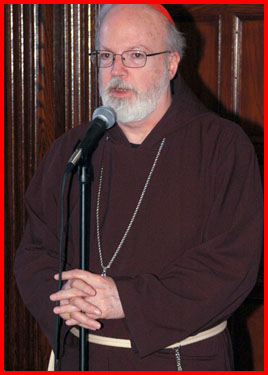
deacons4.jpg

I had Mass with deacons and their wives. They had a magnificent choir. I’m always blown away by the music the deacons are able to bring together. It’s a choir of deacons and their wives, and they are just fantastic! I remembered it from last year. It was the same — the choir was just fabulous.

Following the Mass I joined them for lunch and a time of dialogue.
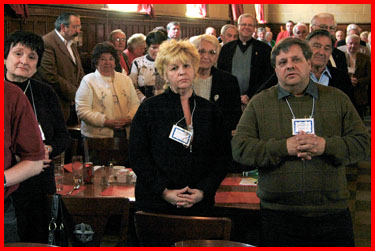
deacons3.jpg

The deacons and their wives join me in prayer before our lunch together

We have a wonderful group of deacons and they are such an important part of the ministry of the archdiocese. We are grateful for their wives and families for making the sacrifice that the deacon’s ministry implies for the whole family. So many of the wives are very engaged in the apostolate.

- – -

The following day the Congolese community at St. Mary’s in Lynn invited me to celebrate the Sunday Mass with them. I was with our new deacon — Deacon Charles Madi, who was ordained in January to the transitional diaconate.

They have a wonderful, vibrant community there. Some of the young African Jesuit fathers who are studying at Boston College celebrate Mass for them regularly and there is a lay woman, Jacky Kalonji, who serves as coordinator of the community.
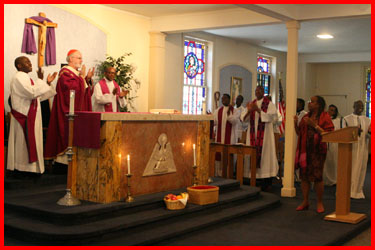
congolese_4.jpg

Following the Mass Jacky Kalonji made some kind remarks thanking me

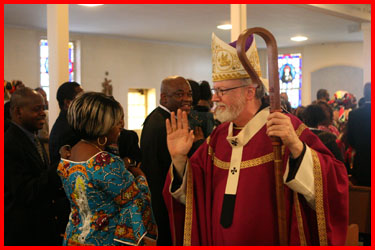
I was very impressed with their celebration. I celebrated the Mass and preached in French. The songs were both in French and in their native language, Lingala. The music was beautiful, and the Mass lasted for around two hours. They said it would have been much longer, but in Lent they keep things more austere!

One of the most interesting moments of the Mass came at the time of the offertory. Rather than passing baskets through the assembly, the people come up in line together singing and put their contribution in the basket. It is certainly something interesting.

They have a wonderful choir of young people. The congregation was full of young families with many young children. Many of them live in Lynn. Msgr. Paul Garrity, the pastor at St. Mary’s, hosts them there.
congolese_1.jpg

congolese_2.jpg

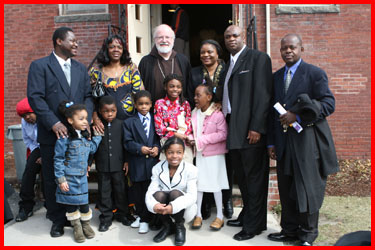
Meeting members of the community

After the Mass we had a luncheon. It was typical African food with fufu, cassava and plantains and more.

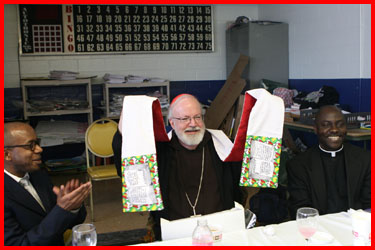
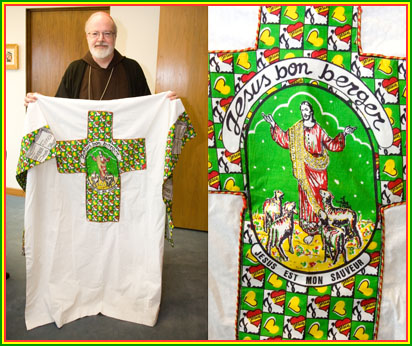
The community presented me with the gift of beautiful vestments in the African style. It was a wonderful present.
congolese_3.jpg

My new stole, part of the vestments they gave me.
To my left is the community’s chaplain Father Donatien Mushi
and on my right is Deacon Charles Madi

- – -

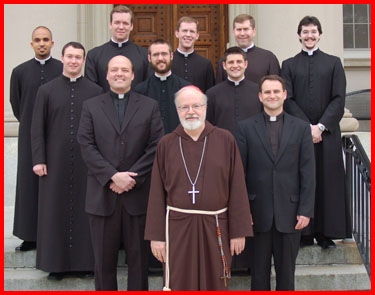
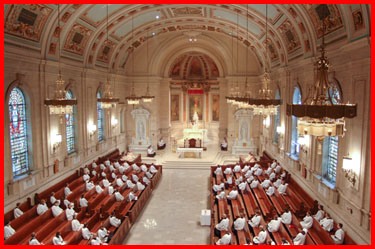
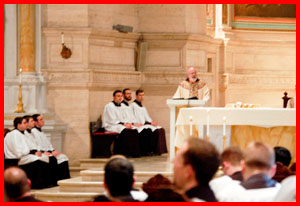
On Monday, the Feast of the Annunciation, I visited our seminarians studying at St. Charles Borromeo Seminary in Philadelphia. They all seemed to be doing very well. Four of them will be graduating and coming up to St. John’s seminary next year.
184.jpg

Our seminarians at St. Charles Seminary as well as
Father Mike and Father Dan from our Vocations Office

I celebrated Mass and later had a dinner with the seminarians. The rector told me I could give them a free day so, of course, the were very happy.
203.jpg

213.jpg

193.jpg

- – -

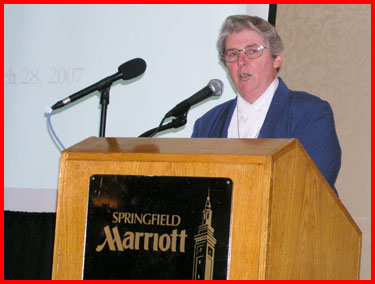
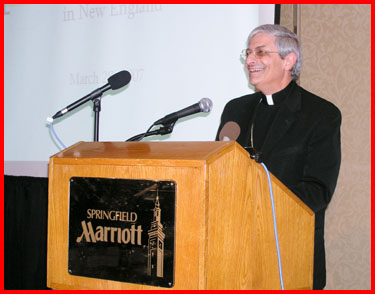
On Wednesday I attended a meeting in Springfield that was sponsored by the New England Conference for Catholic Education. Among those in attendance were all the bishops of New England, with all our superintendent of schools and several pastors.
074.jpg

Our Interim Superintendent of Schools Sister Kathleen Fitz Simons
 

064.jpg

Bishop Salvatore Matano of Burlington, Vermont speaks at the conference

There was a presentation by Father William Davis, Interim Secretary for Education at the U.S. Conference of Catholic Bishops. He spoke of the document that the bishops have written on Catholic education. He also went through a great deal of statistics with us concerning such things as nationwide trends in Catholic education.

It was interesting to learn that 52 percent of Catholic schools in New England have waiting lists, something I wasn’t aware of.
094.jpg

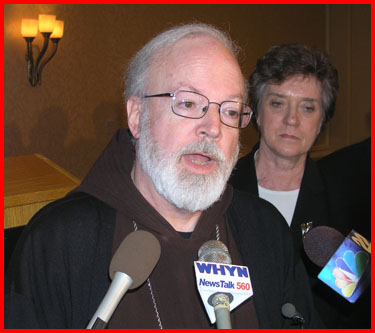
Speaking to the media

We also looked at tuition trends. Many of the dioceses are in a situation similar to Boston’s: They have conducted recent studies of their school systems and are now trying to reorganize to take some of the burden off individual parishes.

Another of the speakers was Mr. Dan Curtin of the National Catholic Education Association was another of those who spoke at the conference. I’ve known him for many years. He was the principal from the school where I had the Spanish Masses in Washington DC when I was first ordained. He went from being principal there to being superintendent of schools for the Archdiocese of Washington and then on to the NCEA. He’s done a wonderful job.

- – -

It was very interesting that the same day the bishops were coming together and studying the situation of our Catholic schools, we had our major fundraiser for the Catholic Schools Foundation’s Inner-city Scholarship Fund which raised about $7 million to help inner-city children attend Catholic schools. Since we have a 99 percent graduation rate and a 97 percent of our graduates go on to higher education, it certainly is a priviledged way for children to find a way out of the life of poverty.

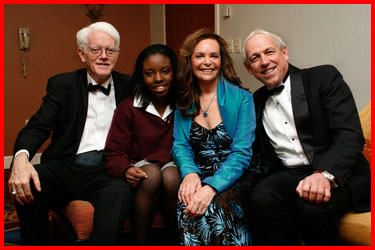
So we are very grateful to Peter Lynch, and Carolyn, his wife, and all those who work with the Catholic Schools Foundation to make this possible.
174.jpg

Peter Lynch, ICFS banquet student speaker Sophia Occena,
Carolyn Lynch and Dr. Jerry Doyle
124.jpg

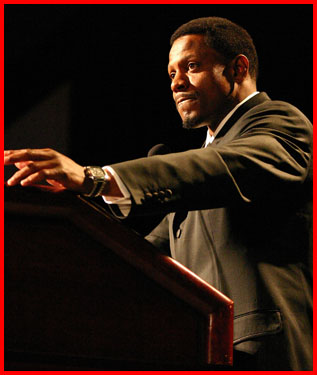
Patriots player Troy Brown speaks at the banquet.
Troy is a trustee of the Catholic Schools Foundation

At the same time, we are working with the 2010 initiative, which is looking beyond just the scholarship money, but trying to improve the schools themselves and to help us to address the implementation of the Meitler study in a way that will be effective.

So many interesting things are happening for Catholic education in our archdiocese. On Thursday, I met with members of a search committee for a new secretary for education — and we are beginning to review candidates. We are very committed to our Catholic schools, and we want our priests and people to see this as a very important part of our ministry — a way of passing on the faith, a way of providing an excellent education for children. There are many different aspects to Catholic education that make it a very valuable ministry that needs to be supported not just by the parents of the children who are in Catholic schools, but by the entire Catholic community.

- – -

It’s hard to believe it is almost Holy Week!

Holy Week is such an important part of our lives and certainly also for a significant group of people in our country who will be receiving the sacraments for the first time. They will be baptized and will be making their professions of faith as new Catholics.

All of us are called upon to renew our baptismal commitment during Holy Week.

On Tuesday we will gather with the priests at the Chrism Mass. On that day all priests renew their own priestly promises. We will also bless the oils for the sacraments, which is a sign of unity. All the oils used for baptisms, anointings of the sick, confirmations and ordinations that take place in the following year will be taken from those oils that are blessed by the bishop and with his priests at the Chrism Mass. That’s always, to me, a very significant moment in our year.

On Wednesday, we will have the celebration of Tenebrae. It’s basically the praying of the psalms and the lessons from the breviary.

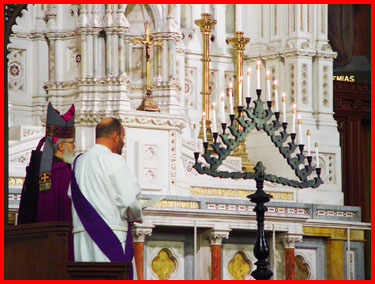
It takes its name from the fact that as the psalms are prayed we extinguish candles on a very large triangle called a “hearse.” Once the candles are all extinguished, the church is in darkness. “Tenebrae” means “darkness” in Latin.
223.jpg

The Tenebrae hearse. You can see form the photo how large it is.

The liturgical books call for us to publicly celebrate some of the hours of office in Holy Week with the community, so we have chosen the Tenebrae as an opportunity to do that. It’s been a popular practice in the Cathedral for the last three years.

Holy Thursday, of course, is so important as the day of Eucharist, the day of the ordination of the apostles, the day of Jesus’s arrest. It is one of my favorite days of the week. We have Adoration until midnight in all our churches. It is edifying to see how many people come, particularly university students come from different campus ministries in large numbers to visit the Blessed Sacrament and pray.

Friday we’ll have the afternoon services in English and then in the evening have them again in Spanish together with a procession through the housing projects in the neighborhood where we will pray the Stations of the Cross through the streets. Many people form the neighborhood participate.

And of course, the Triduum concludes with the Vigil and Easter Sunday. As in years past, I will celebrate the Easter Vigil at the cathedral.

I leave you with my photo of the week: a picture of the beautiful vestment given to me by the Congolese Catholic community in Lynn. I have included a close-up of the detail so that you can read the inscription. For those of you who don’t speak French, on the top it reads, “Jesus the good shepherd” and below is written “Jesus is my savior.”
photoweek.jpg

Until my next post….

Have a blessed Passion Sunday and Holy Week,

Cardinal Seán

Celebrating together

This week began and ended with two different kinds of events. Last weekend we had the Men’s and Women’s Conferences which brought thousands of Catholics together to celebrate their faith. Yesterday, I attended the Anti-Defamation League�s �Nation of Immigrants� Community Seder, that gathered hundreds from many ethnic and religious backgrounds to experience the most ancient liturgy for the people of Israel.

On Saturday, the vocation novena to St. Patrick culminated in our celebration of the patronal feast day, held at the Cathedral of the Holy Cross each year. This year, Bishop John Dooher celebrated the Mass.

That same day I participated in the Boston Catholic Men�s Conference at the Convention and Exhibition Center. We were so pleased that, despite a terrible snowstorm, many men were able to make it there. Over 3,000 men participated in the day, and only one of the speakers, Patrick Madrid, was unable to arrive. I was anxious for people to hear him because he is a wonderful apologist. He has the ability to explain the Catholic faith from the biblical point-of-view. When I was in the Virgin Islands, I had him give talks down there. Patrick attempted to get another flight from Ohio but just was not able to.

It was a loss that Patrick could not be with us, but we were grateful to Andreas Widmer who filled in for him. Widmer is a former Swiss Guard and gave us a wonderful testimony about his personal experience of working with Pope John Paul II. He also included a slideshow of the Holy Father and the Swiss Guard, which I think the men enjoyed very much. This year the Swiss Guards are celebrating their 500th anniversary, so having a former Swiss Guard speak at the Men�s Conference was very appropriate.

063.jpg

Andreas Widmer

Later in the day, Carl Anderson gave a superb talk. It was a real message about what Catholic men can do in society and in our democracy. He gave an account of the accomplishments of the Knights of Columbus and other Catholic men in the face of great prejudice against the Catholic Church and her teachings. Carl�s grasp on the history of Massachusetts and the vicissitudes of the Catholic community here was very good. Historically, Massachusetts Catholics have faced many challenges � with the Know Nothing Party in the 1850s and others � who have tried to impinge on the Church�s freedom and ability to carry out her mission.

Carl�s message was very, very timely. He spoke about the defense of life, the defense of the family and on the importance of protecting people�s right to live according to conscience. The challenges that we face today are very great, and it will require the dedication and determination of our Catholic laity to be able to respond to the situations we face today in our commonwealth. His talk is available at the knights of Columbus Web site.

59.jpg

Supreme Knight Carl Anderson

Cardinal Peter Turkson from the Archdiocese of Cape Coast in Ghana also spoke at the conference. I have known him since he was a young priest. He talked about the Church as family and used many paradigms of the African Church to explain how our mission requires us to tell our story. He stressed that we need to initiate our young people into the history of salvation and that all Catholics must be given responsibilities in the Church. It is important that they feel they are part of the Church�s mission. They need to understand that each individual is called to live a vocation and a life of discipleship in such a way that it makes an impact on the world around us.

143.jpg

Cardinal Peter Turkson

I was delighted by the talk given by twin brothers Father Roger and Scot Landry. Father Roger is a pastor in the Diocese of Fall River and editor of their newspaper, The Anchor. Scot, co-founder of the conferences, works for the archdiocese as the Secretary for Institutional Advancement and Chief Development Officer. Both men gave a powerful witness about vocation and the call of Christ to Catholic men to help rebuild the Church.

073.jpg

Father Roger and Scot Landry

The music at the Men�s Conference, led Martin Doman, was also outstanding. They wrote a beautiful rendition of the Lorica prayer, also called the Breastplate of St. Patrick, which they sang many times during the day. It became the theme with the words, �Christ is before me.� That was very moving.

123.jpg

The musical performances throughout the day
led by Martin Doman were inspiring

Dana Scallon, a Christian singer and Irish politician who also spoke the next day at the Women�s Conference, sang �Our Lady of Knock� at the Mass.

301.jpg

In addition to the Mass, there were opportunities for the men to participate in confession and adoration. Many priests, including myself, heard confessions for many hours.

093.jpg

It was encouraging to see so many eager to
partake in the sacrament of reconciliation

113.jpg

Before the Mass, Father Dan Hennessey led the men in Eucharistic adoration

183.jpg

173.jpg

163.jpg

I celebrated the Mass at both the Men’s and the Women’s Conferences. I am sharing with you highlights of the Saturday sermon:
At the department store and malls, we often see a sign that says: �Lost and Found.� That sign could very well be hung in our churches somewhere over the confessional � It is the lost and found department.

When we lose something important like a wallet or a wedding ring, we suffer. But a prayer to St. Anthony, we find the ring in between the cushions on the sofa, and we are filled with joy, excitement and relief. That is the way Jesus speaks about the remarkable connection between repentance and joy.

262.jpg

Delivering my homily

The Gospel groups three stories about Lost and Found �the lost sheep, the lost coin, the lost son, the Prodigal Son who finds his way home. They all speak to us about God�s joy over one sinner who repents. And truth be told, they speak to us about the joy of a sinner who experiences God�s loving forgiveness.

The younger son, the Prodigal Son, wants to make his life without the Father. (He demands his inheritance as if the Father were already dead. The younger son would have been entitled to one third of the estate according to the Jewish practice of the time.)

Sin is when we try to live our life without God. We take all the gifts He has given us, and we resolve to use them for our own benefit and enjoyment without much thought about others� needs.

271.jpg

The prodigal son�s agenda is to have fun. I always say that we arrive at maturity when we discover the difference between having fun and being happy. The son suffers a rude awakening when the money runs out. But the Gospel says, �When he came to himself.�

The Church’s task is simply to call people home, to walk the paths that God has traced on our hearts. The young man�s money ran out, he begins to feel the humiliation of his circumstances. Without money or real friends he has been reduced to taking care of the pigs — unclean animals in the Jewish religion. To stress the degradation of his situation, the parable describes the man as begging for the food they are feeding the pigs. His situation was deplorable. So, he comes to his senses and longs to be back in his father�s farm. He knows he is unworthy to be a son, but would gladly work as a farmhand. He sets out to return home, practicing his lines like a young man waiting to go to confession.

192.jpg

Abraham Lincoln was asked how he was going to treat the rebellious southerners when they had finally been defeated and returned to the Union. To the surprise of his questioner who hoped for vengeance, Lincoln replied: �I would treat them as if they had never been away.�

The Father receives the Prodigal Son back not as if he had never been away, but welcomes him with such special affection and in a very public way. He exchanges his rags for the finest clothes, puts sandals on his feet and a ring on his finger.

The Father has been waiting, hoping, searching the horizon, and when he spies his boy far off, he runs out to welcome him home. Our repentance meanders along slowly, God�s mercy runs swiftly to meet us.

The Father embraces and kisses his prodigal son. And even before the Son has a chance to offer explanations, excuses or promises, he is received as a Son.

222.jpg

The older son lived in a secret alienation. He did not feel appreciated and expresses his silent rage by refusing to enter the house. His anger toward the Father is deflected toward the Son whom he considers privileged and unworthy. In fact, it is the elder brother who gratuitously lists the sins of the Prodigal Son, mentioning how he wasted his father�s money on prostitutes. He then indicts the Father, �I slaved for you. You never even killed a goat for me��

But, the Father also seeks him out to comfort the elder son and to reassure him. �You are always with me. Everything I have is thine.� The Father is unconcerned about his property and his honor. He is concerned only about his sons.

The Parable defines the mercy of God and the mission of Jesus who has come to call sinners. The parable is occasioned by the grumbling of the Pharisees who refuse out of envy and resentment to accept this good news extended to the outcast. They resented others being accepted without cost. God�s mercy is challenging to the proud hearted.

The Parable speaks to us about God�s mercy and the connection between repentance and joy. Sadness and death are the fruit of sin. Repentance is a resurrection. Rejoice, your brother was dead but has come back alive. Hollywood loves sequels. I am waiting for Rocky 16 when the 85 year-old Rocky Balboa defeats the Russian by bludgeoning him with his walker.

Allow me to add a sequel to this story about a Prodigal Son, about how he returned to the man who had enslaved him and made him care for the pigs. The Prodigal Son I refer to is Patrick.

282.jpg

You�ve seen the buttons that say, �Kiss me, I�m Irish.� Patrick won�t wear one because it�s tacky, and Patrick was not Irish. He was an Irish wannabe. In today�s world America is the superpower. As Americans, we feel a sense of pride, of superiority and consider our way of organizing society the best. Patrick was a citizen of the superpower of his day, the Roman Empire. They looked upon those outside the Empire as Barbarians and saw themselves as representing what was advanced, noble, the rightful rulers of the universe.

Patrick, whose name Patricius means noble, was the son of a deacon living at the edge of the Roman Empire in Britain. Although his family was Catholic, Patrick was not a devout or even practicing Catholic. He was leading a comfortable life as a son of landowning aristocracy. We have two remarkable letters that Patrick wrote that reveal much about Patrick�s spiritual journey and what he held in heart.

Just before his 16th birthday, Patrick was kidnapped by Irish pirates, a profession not unknown to the O�Malley Clan, and abducted to Ireland where he spent six lonely years as a slave in conditions that would make Angela�s Ashes sound like an advertisement for a luxury resort. Patrick was cold, hungry, lonely and afraid. Like the Prodigal Son, he was envious of the pigs and sheep he tended. Trapped in a foreign land, despondent and at the mercy of his master, Patrick�s ordeal turned him from a practical atheist to a true believer.

After six long years in a foreign country in slavery, Patrick escapes and returns home. We can imagine the joy with which his family received him. Like the family of young Shawn Hornbeck rescued in St. Louis after being kidnapped five years ago.

242.jpg

A good number of priests concelebrated at the Mass

231.jpg

I am sure that Patrick�s father, the Deacon Calpornius, embraced the son he never thought he would see but who longed for his return. I am sure that Patrick�s father put the finest clothes on Patrick�s back to replace the smelly rags he wore as a slave. I am sure that they killed the fatted calf to try and fatten the emaciated lad who returned like the Prodigal Son. Patrick returned dirty and starving, but inside he had changed even more than he had on the outside. He was no longer the self-centered, worldly, pleasure-seeking youth. In the horrors of bondage, Patrick discovered God. His newfound faith and intense life of prayer allowed him to survive the ordeal.

The sequel to the story of the Prodigal Son begins after Patrick�s family clean him up and feed him. The shocking revelation was that Patrick wanted to return to Ireland. He did not plan to raise an army and return to punish the pirates who captured him and humiliated him. No, he planned to return to share his newfound faith in God.

His captivity was a novitiate that prepared him to speak the difficult Irish language, eat our food, (the shortest cook book in the world is the Irish Cook Book) know the customs, the culture. It was a unique preparation that equipped him to be the Apostle of Ireland.

Patrick followed Christ�s command, to love our enemies and to do good to those who persecute us. Chesterton said, �God told us to love our neighbor and our enemy because usually it is the same people.

But what really equipped him was the grace of forgiving. By forgiving those who had wronged him, Patrick made himself available for God�s work.

Forgiving at that magnitude transforms a person. That is when Patrick became a freeman, not just when he cast off the chains of slavery, but when for love of God he could forgive his enemies who robbed him of his youth.

When John Paul II went to Regina Coeli prison to meet the man who shot him, Mehmet Ali Agca, the world was stunned. The Pope forgave him from the heart and even received his parents. When the Amish children were murdered in their school house, the world was shocked by the attitude of forgiveness.

291.jpg

Distributing Holy Communion

According to the story the man who owned Patrick as a slave committed suicide when he heard that Patrick had returned to Ireland. He presumed Patrick returned for revenge. The real reason was to forgive, to love, to share his life-giving faith with them. A thousand years before Columbus arrived on these shores, Ireland was a Catholic country.

I attribute much of Patrick�s spiritual success to the great grace of forgiveness in his life. Patrick also instilled in the people he evangelized a great desire to share the faith. Hence, Ireland has become the greatest missionary country in the history of the Church. On this feast of Patrick, the Bishop, Evangelizer, I would ask every man here to live these ideals of Patrick. First of all by forgiving anyone in your life who has offended, or disappointed you. And secondly, love Christ, walk with Him and then look for ways to share that love with your family, neighbors, friends as well as strangers and maybe like Patrick even with your enemies.

On judgment day the first three hours will be to give everyone time to return borrowed books. After that we will have to listen to people say nice things about us or complain that we ignored them in their hunger or time of need. The saddest thing will be hearing the complaints from our children and friends who will say: why didn�t you tell me about Christ, why didn�t you invite me to Mass, teach me about prayer, tell me about the urgency of the Gospel, why didn�t you share your faith with me?

Two thousand years ago a small group of disciples of men gathered around Jesus, the Risen Lord as He returned to the right hand of the Father � His final orders were: �Go and make disciples of all nations, baptizing them and teaching them to observe all the commandments which I have given you and Behold I am with always, even to the end of time.

We are here because generations of Catholics passed on the faith. Now it is our turn. It takes courage to be a disciple, to announce the good news. True disciples in every period of the Church�s history have had to struggle, to suffer, to pass on the treasure of our faith.

Christ is counting on us, each of us � to live our vocation, to witness to our faith, to share a mission He gave 2000 years ago. We must live our faith or we will lose.

We must transform the world around, build a civilization of love. The word of God, the fellowship with our brothers and sisters in the faith, the Eucharist are the source of our strength as we live the mission we share.

Christ is counting on you, one man, one Catholic man � makes a difference � this big group will make a big difference.

- – -

That evening I attended the Clover Club annual St. Patrick�s Day dinner. The Clover Club is a fraternal association of men of Irish descent who gather several times a year for an evening of socializing and enjoying literary and musical entertainment. I was invited by the Club President, Mr. Gregory Plunkett, and the Dinner Chairman, Mr. James O�Connor. Jim is a member of the Archdiocesan Finance Council who last year chaired the Archdiocesan Operations Review Committee. There were over 700 in attendance at the dinner, held at the Park Plaza Hotel in Boston.

It was a festive evening with singing, skits and political roasts. They roasted the governor, mayor and former governor. In a way I was glad that I was there because otherwise they probably would have been roasting me!

I closed the evening with a talk in which I shared humorous recollections of my Irish heritage as well as a spiritual reflection for the Lenten season.

- – -

On Sunday the weather was better for the Women�s Conference, and they were able to get there without problems.

035.jpg

Over 4,000 women arrived at the conference. It was a very good experience for them. They had wonderful speakers. In the morning, Sister Linda Koontz gave an engaging talk that the women liked very much.
Dana Scallon, a Christian singer and Irish politician, gave a beautiful testimony of her life, interspersed with the songs she has written. She had been a member of the European parliament for five years and ran for president of Ireland. She was also on the forefront of the pro-life cause in Europe and in Ireland, specifically.

043.jpg

Dana Scallon addresses the Women’s Conference

The final speaker of the day was Immaculee Ilbagiza, a survivor of the Rwandan genocide. She gave a moving testimony of that horrific experience. She spoke of the great loss of her family and her loved ones but also about the power of prayer, especially the rosary, in her life. She talked about the need to forgive ones enemies for love of God.

55.jpg

She is a young beautiful girl, full of life, and it is hard to imagine how that genocide could have taken place. But the genocide is a reminder of the great evil that the human heart is capable of. As we see in the Nazi holocaust, the terrible genocide in Rwanda and our more recent history, if people separate themselves from God, great evil can be unleashed in their lives and in the world.

023.jpg

014.jpg

At both conferences, men and women were recognized for their outstanding roles in the life of the Church. The awards were a fine recognition for people who are very involved. We congratulate those who have been singled out and thank them for all that they do for the Church and God�s people. Obviously, the awards do not mean that there are not many other people who deserve to be recognized. In fact, having recognition shows the great gifts that come to the community in so many people.

053.jpg

Sister Mary Ricci Lloyd receives her award for Religious Sister of the Year

- – -

This week I also traveled to Washington D.C. for two meetings at the U.S. Conference of Catholic Bishops, one with the immigration committee and the other with the pro-life committee. During the meeting of the immigration committee, we continued our discussions on the need for immigration reform, comprehensive immigration legislation and the Church�s work with refugees. There is much concern about refugees from Iraq, particularly the Chaldean Catholics who have had to flee that country. The bishop�s conference will be holding a convention on immigration next month in Washington in an effort to focus people�s attention on some of the needs that we face in this area of immigration.

I am also a consultant on the Pro-life committee, and we had an interesting meeting. A lot of different materials were shown on stem-cell research. Bishop Thomas Wenski from the Diocese of Orlando and Bishop Nicholas DiMarzio from the Diocese of Brooklyn made a presentation on the political responsibility document that the bishops conference will publish in the near future. The document is meant to present the centrality of the pro-life message and help people understand what is meant by formation of conscience.

- – -

On Thursday evening I participated in the Anti-Defamation League�s �Nation of Immigrants� Community Seder that took place at The Castle at Park Plaza in Boston.

Last year I gave a speech to the Jewish community in which I told them about a Seder meal that I organized in Washington with the Hispanic Community many years ago. In response to my talk, this year the ADL has organized a multicultural Seder inviting many ethnic and religious groups. Andrew Tarsy, ADL regional director and Diane Rosenbaum, Senior Associate Director did a wonderful job organizing the event. It was a lovely evening.

47.jpg
Andrew Tarsy

311.jpg

Every participant was asked to place a pin in a map indicating the country
of their ancestors. Of course I put mine in County Mayo

401.jpg

Rabbi Neal Gold from Temple Shir Tikva, Wayland
leads us through the Seder

361.jpg

Cantor El�as Rosemberg, Temple Emeth, Chestnut Hill
sang the Seder melodies wonderfully

48.jpg

The booklets explained each step of the ritual.
They were very useful

43.jpg

Dipping a finger in the cup of wine and dripping
ten drops in remembrance of the ten plagues of Egypt

49.jpg

Eating the unleavened bread, called Matzah

39.jpg

With me at the table were Marshall and Barbara Sloan.
Here I am passing Marshall the bitter herbs

58.jpg

Seder meals are an important way for Catholics to have a sense of what the ritual at the Last Supper would have been and how Jesus, taking the unleavened bread and the wine, made them into the Eucharist. In the Jewish tradition the Seder is a family meal. Jesus, rather than celebrating it with his family, celebrated it with his disciples who were his spiritual family. During the Seder, children ask questions like �Why is this night different from any other night?� At that meal, St. John, being the youngest, would have been the one asking the questions. The Seder meals are helpful to understand what Jesus and His disciples did.

42.jpg

The cup of wine used at the Seder meal

I was happy that the Hispanic Choir from Our Lady of Lourdes was there, with a couple of Capuchin friars accompanying them with musical instruments.

51.jpg

The choir of Our Lady of Lourdes

There were a couple of Jewish youth groups that sang as well.

46.jpg

41.jpg

321.jpg

The mayor was also in attendance

At the Seder, I announced that Pope Benedict XVI has named Rabbi Leon Klenicki to the Papal Order of St. Gregory.

351.jpg

Rabbi Klenicki has been a pioneer in Jewish-Catholic relations for decades. His own personal experiences of anti-Semitism led the Rabbi to be a passionate advocate for education as means of dispelling religious prejudice and promoting interreligious collaboration.�

On the occasion of the 50th anniversary of the Warsaw ghetto uprising, Pope John Paul II said, �As Christians and Jews, following the example of the faith of Abraham, we are called to be a blessing to the world. This is the common task awaiting us. It is therefore necessary for us, Christians and Jews, to first be a blessing to one another.� Rabbi Leon Klenicki�s life has been the source of blessings for all of us. We are deeply grateful for his witness and his work.

45.jpg

The Seder was very well attended

In naming Rabbi Klenicki to the Papal Order of St. Gregory, Pope Benedict XVI has bestowed the highest honor the Catholic Church confers on a layperson, in recognition of �Outstanding Services Rendered to the Welfare of Society and the Church.�

- – -

Today, as I was having lunch at my office with my friend John McNiece, my staff surprised me with an anniversary cake. It was one year ago that the Holy Father elevated me to cardinal. Time flies!

For the photo of the week I leave you with this photo of our celebration. And, in case you are wondering: yes, the cake was delicious.

53.jpg