Â
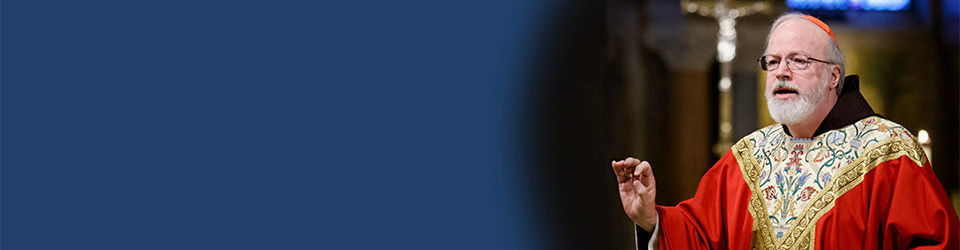
Everyone was very pleased by the great outpouring of enthusiasm and love for the archdiocese that was evidenced in the celebration of the Mass closing the Bicentennial Year.


We opened the Bicentennial Year on the first Sunday of Advent, which is the first Sunday of the liturgical year. We ended the Bicentennial celebration on the last Sunday of the liturgical year, the Feast of Christ the King, which was a very fitting occasion to conclude our celebration.
The Feast of Christ the King is a beautiful time for us to reflect on our history. The gospel is from Matthew 25, and it described the time Jesus tells the Apostles: “What you did not do for the least ones, you did not do for me.â€
In my homily, I said this prompts us to reflect on the history of the good works of the Church and how we are trying to fulfill that special command from Jesus to have a special love for the poor, the sick and the disenfranchised.

I also spoke on Jesus’ new commandment: that we seek the love that should unite us as disciples in his body. It is the kind of love that is nourished in the Eucharist. I challenged all of our people—as I did in the beginning of the Bicentennial Year — to be Apostles of the Sabbath, to be a welcoming and inviting Church, to gather people around the Eucharist, to bring people to Christ.
We were pleased that Cardinal Rigali, Archbishop Hughes and so many other bishops and more than 150 priests participated.


There were also many deacons and religious there, as well representatives from the Knights and Ladies of St. Peter Claver, the Order of Malta, the Knights and Ladies of the Holy Sepulcher, the Knights of Columbus and the Catholic Daughters.


When I looked out into the crowded pews, I saw so many different ethnic communities, parishes and various youth groups. I was struck by how the catholicity of the Church was showcased by the liturgy and particularly the music. It was so beautiful to hear the intercessions expressed in different languages of the Church in Boston. We were also pleased to see a strong turnout from the new Syro-malabar parish.


I was also very happy that Father John Connolly arranged for the Boston Police Gaelic Column of Pipes and Drums to play before the Mass. They added a great festive spirit to our celebration.

 Â
Â
During the Mass, we blessed the Bicentennial Plaque, which will be a permanent marker at the cathedral of this remarkable year.


Also at the Mass, after Communion, we awarded our new Cheverus Medal to 68 individuals who have given outstanding service to the Church. The nominations for the medal came to the regional bishops, who then submitted them to me. They are all people who have given years of service to the Church. Being able to present the medal for the first time was very special.


My plan is to have the pastors and the parish councils recommend people, particularly volunteers, for the Cheverus Medal based on years of generous service, which will be awarded every year on the Feast of Christ the King.

Bishop Cheverus was a very holy missionary. He lived his faith courageously, during a terrible time of persecution, coming here from France with Father Matignon. At the time, they were the only priests in Boston.

These two men really established the Catholic Church in Boston.
Bishop Cheverus was the first bishop and his motto: “Diligamus nos invicem†or “Let us Love One Another,†which is inscribed on the medal, is a reminder of the new commandment that we must love one another.
I’d like to share my homily with all of you here:
Thursday I offered Mass for all of you and for the whole Archdiocese at the tomb of St. Peter, the Rock on which Christ has built His Church. As we gather to celebrate 200 years of our history as the Church of Boston, we thank God for the blessings we have received and ask forgiveness for our failures.Â

Today, I recall something I have heard Tom Finneran say on various occasions, a declaration that has touched me very deeply. He says that no government, no other Church, no organization, no political party has fed, clothed, educated as many people, cared for as many sick, buried the dead or even begun to perform the works of mercy performed by the Catholic Church.


In our short history, the Catholics of Boston, despite the many challenges and the prejudices against us, we have made many contributions to our local community. In the last century our Archdiocese’s Catholic elementary schools educated 1.1 million students. A half a million students graduated from our high schools, Catholic orphanages cared for over 25,000 orphans. Catholic Hospitals have served 3.5 million individuals. In the last four decades, the Archdiocese’s Urban Planning Office has provided permanent affordable housing for 11,000 people and the number of those served by our Catholic social services, food pantries, Cor Unum, St. Vincent de Paul, Catholic Charities is estimated to be in the millions of individuals.

We are not here to brag. In the Gospel, Jesus tells us: “When you have done all you have been commanded, say: ‘We are useless servants; we have only done what we had to do.’â€Â (Luke 17:10)  Perhaps we should have done more. More than pride, we feel gratitude that Christ gave us the faith and love to be able to do what we have done. We have simply done what He commanded us, to love our neighbor, to feed the hungry, care for the sick, share with the poor. And all things we do for the least of our brothers and sisters we are doing for Jesus. And what we fail to do to them, we fail to do to Jesus.
Among the stories I remember from childhood, I recall one about a good king who disguised himself as a peasant and traveled around his kingdom to get to know his people, their reality, their suffering so as to be a better king.
Jesus is the good king that comes to us in human vesture as a good shepherd. He does not come to get to know us, but so that we can know Him, so that we can experience His love. He came to teach us about love so that we can learn to love and thus become part of His Kingdom.

As children we used to play hide and seek. Our God is playing hide and seek with us. He hides in the form of a little baby. He hides in the form of bread. And when our God is crucified, He is the most hidden. And today’s parable reminds us that our God is to be found hiding behind the faces and places of suffering people: the old woman with Alzheimer’s, the drug-addict, the AIDS patient, the homeless schizophrenic off his meds, the autistic teenager. They are the ones Jesus calls the least of our Brothers and Sisters, the ones He identifies with completely. They are as Mother Teresa says, Jesus in a distressing disguise.

The Holy Father Pope Benedict XVI has commented that the Gospels indicate that Jesus uses the expression “Brothers and Sisters†to describe two categories of people. First there are the poor, the sick, the prisoners, the least of our brothers and sisters in today’s Gospel. Jesus also uses the expression “Brothers and Sisters†to describe His followers, the members of the Church, those who are striving to follow Him, to do the Father’s Will, to be members of His family, the Church.

Today, we gather to celebrate the fact that in Christ we are truly brothers and sisters. Sometimes there are tensions in a family. There are sibling rivalries. But discipleship in the Church means being brothers and sisters in the Lord.
On the night before His death on the cross, Jesus gathered his Apostles in the upper room. There He bid us farewell and gave us a New Commandment and a new Sacrament. The Great Commandment had been that we love God above all else and that we love our neighbor as ourselves. But now at the end of His time on earth, Jesus gives us the New Commandment. He washes the feet of His disciples as a striking gesture of what Eucharist is about, and He gives us a New Commandment: “Love one another as I love you.â€Â This commandment is directed in a special way to those who are members of the Church, Jesus’ disciples, Jesus’ family. We must love each other as Jesus loves us. Jesus’ love is the measuring stick for the fraternity that must characterize the community of faith.

Love as Jesus loves: those are our marching orders. How did Jesus love us? Jesus loved us first, while we were still in sin, still indifferent to His love. So often we wait for others to love us, forgive us, give us something—then we reciprocate. But Jesus wants us to love first, to forgive others, to the end, to the point of laying down our life.
John the Evangelist wrote about the New Commandment in his description of the Last Supper. It is said that at the end of His life, St. John the Apostle was in exile on the Island of Patmos. He lived in a cave in the hills. Each Sunday they carried St. John to the village to preach at the Sunday Eucharist. And each Sunday John gave the same sermon. Finally someone had enough courage to ask why he always preached the same sermon, he said that he preached, “Little children, love one another†each Sunday, because when the Master walked with us on the earth, Jesus said over and over again: “love one another.â€Â Our first Bishop, Bishop Cheverus had these words as his motto – Diligamus nos invicem: “Let us love one another.â€Â These are the words inscribed on the Cheverus Medal.


Jesus wants us to be brothers and sisters to the poor and suffering. He also wants us to be brothers and sisters in a very special way with our fellow members of the Church, the family of Christ. At the first Eucharist, the Last Supper, Jesus gives us the new commandment of fraternal love among His disciples, and He gives up the gift of Himself in the Eucharist so that we might have the strength to make a gift of ourselves to God and to one another.
In the Eucharist, we discover God’s love, who we are, and why we are here in this world.Â
In his homily at St. Patrick’s Cathedral, Pope Benedict commented on the stained-glass windows. When we look at them from outside, they seem dark and dreary, but inside the Church the windows are splendid with a light and color and a beauty that teaches the mysteries of faith. One can only really appreciate the beauty of the Church from the inside. The Church is a gift to mankind, which has been brought into being according to the eternal plan of God. Her mission is to continue Christ’s work of salvation. The Church is at the service of our authentic freedom by opening a window onto God and the eternal, the Church takes us beyond the limitations of this world, it points to the depths of God’s love for us.
We must never tire of inviting people to come into the Church, to discover the beauty and light inside. Part of our mission is to build up the body of Christ, the Church, by being an inviting and welcoming community. Be Apostles of the Sabbath.
In the year 304 in North Africa a number of Christians were arrested for gathering together to celebrate the Eucharist on Sunday. When the pro consul challenged them for doing what was forbidden, a Christian named Emeritus answered: Quoniam sine dominico non possumus – “Without the day of the Lord, we cannot live.â€Â Pope Benedict commented on this history by saying “For them it was not a question of a choice between one precept and another, but rather a choice between all that gave meaning and consistency to live and a life devoid of meaning.â€

The Sunday Mass obligation is a sign of fidelity, but it is not an external legalism. We have an obligation to celebrate our Mom’s or Dad’s birthday, but we do not see that as a constraint or an imposition but rather an expression of our love, of who we are. If we want to love God and love our neighbor and yet do not want to join our neighbor in worshipping God, then something essential is missing in our lives. Being a Catholic today more than ever means being an Apostle of the Sabbath, helping the Good Shepherd to gather His people so that we can be Christ’s Family, Christ’s very Body.
A year ago we began our observance of the Bicentennial on the first Sunday of Advent. I asked our Catholic people to put a light in the window harkening back to the old Irish custom at Christmas time. In the Penal Days it meant that a Mass was to be celebrated clandestinely in a home. It was also seen as a sign that there was room in the inn, that the Holy Family would be welcomed there.
At the end of our observance of the Bicentennial Year, I ask you again to place the light in the window. Christ said: “let your light shine before men.â€Â Today’s Gospel reminds us that that light is love – a love that is spontaneous and gratuitous, a love that is a response to God who first loved us.
Our task is to work together to make Christ’s Kingdom of love, truth, justice, and peace more present and more visible. It is a great challenge, but we are the Church of the Martyrs, the witnesses of the Church’s faith in the Resurrection of Jesus Christ, and in the mission of His Church. It is never easy.
In 1927 on this very date, November 23, a young Jesuit priest, Father Miguel Pro, 36 years old – that is young for a Jesuit – stood before a firing squad in Mexico City. He declined the blindfold and stood with a crucifix in one hand and a Rosary in the other. As the soldiers took aim, he shouted with every fiber of his being – “Viva Cristo Rey†– “Long live Christ the King!â€
Today we stand in the shadow of the Cross, that living symbol of God’s love and shout “Viva Cristo Rey.â€Â Let us rededicate our lives to the mission that Christ has entrusted to us. Let us serve Christ in the poor and the sick. Let us love each other as Brothers and Sisters in the Lord. Only what is done in love will last. Only love brings life and joy. As today’s Gospel tells us, all the way to heaven is heaven.
 Â
Â
The Good Shepherd is gathering us and feeding us to make us collaborators in His Mission. He is inviting us to inherit His Kingdom of love and of joy. On Good Friday, the people shouted, “We have no king but Caesar.â€Â Today we say, “We have no King but Christ.â€Â Together, let us make our lives a prayer – “Thy Kingdom come. Thy Kingdom come!â€
– – –
During the course of my meetings in Rome last week, I had the opportunity to see a number of friends. I was hoping to mention them last week but I was waiting to receive the photos.
Every time I visit Rome, I enjoy meeting the local priests and seminarians who are spending time there. So this time was no different and I had dinner with a number of them.

Here I am with Msgr. Bob Deeley who is on lend-lease at the Congregation for the Doctrine of the Faith; Eric Bennett, a Boston seminarian studying in Rome; Father John Cappucci, who was in Rome on Sabbatical and is coming back to become Pastor of St. Malachy’s in Burlington; Msgr. Paul McInerny who is teaching at the Urbaniana University; Father Derek Borek, who is studying in Rome and my secretary, Father Jonathan Gaspar.
I also want to mention that Father Jose Herrera, a priest from the Virgin Islands who is currently a military chaplain in Vicenza in Northern Italy, came down to spend a couple of days in Rome while we were there.
Another evening, I was happy to have the chance to have dinner with Mary Ann Glendon, the U.S. Ambassador to the Holy See and Father David Pignato, a priest of Fall River, who is studying for his doctorate with the view to becoming a professor at our St. John’s Seminary.
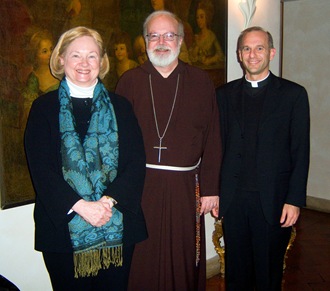
It was wonderful, especially hearing Ambassador Glendon’s reactions to what is happening in the Church and the world today. She is so knowledgeable about world affairs and the situation of the Church.
Many friends in Italy have told me what a positive impression Ambassador Glendon has made. She has been interviewed on Italian television many times and she speaks excellent Italian. Although her tenure in Rome has not been a long one, she has made a wonderful contribution and one that all Americans can be proud of.
– – –
Saturday night I was at the Bishop James Augustine Healy Award Dinner. Every fall, the Office of Black Catholics presents the Healy Award to an outstanding member of the community.
At this year’s dinner, held at The Lantana in Randolph, the award was presented to Mercedes Evans, who is an attorney at the Massachusetts College of Art.
 Bishop Boles introducing Mercedes Evans
Mercedes grew up in Baltimore, where she went to Catholic schools. I learned that her mother studied with the Sisters of Providence, which is a community of black Catholic sisters founded in that city.
It was wonderful to see Mercedes joined by her children and her brothers and sisters. Bishop Boles, who for many years was her pastor, introduced her.
 Â
Â
Also at the dinner, there was a keynote address delivered by Auxiliary Bishop of Brooklyn Guy Sansaricq, who is Haitian. Â

When I began the Haitian Apostolate in Washington in 1972, Bishop Sansaricq was the one I turned to for help. He was then the pastor of a very large Haitian parish in Brooklyn. I was so pleased to hear that he was named a bishop.

This is, of course, his second visit to the archdiocese this year. The Haitian Catholics had their annual convention here in Boston earlier this year and he was part of that event. It was good of him to deliver the keynote and stay for the closing Mass of the Bicentennial Year the next day.
– – –
Monday night, I was in the North End with members of Memores Domini. This is a lay institute of consecrated life that came of out Msgr. Luigi Giussani’s Communion and Liberation movement in Italy.

The members are men and women who live in communities and make promises of poverty, chastity and obedience. They also promise to live by the rules and spirituality of the movement.
In Italy, there are many professionals, especially doctors, who are Memores Domini. A number of members have come here from Italy and formed a community here in Boston.
In the past, popes would have nuns operate their households, but Pope Benedict XVI has consecrated laywomen members of Memores Domini instead.
The gathering Monday was a dinner to celebrate that one of the members, Alessandro, is going back to Milan to make his profession.
There are four members in Boston, and they have a larger community of women in New York City. My understanding is that they have hundreds of professed members around the world, but they are strongest in Italy.
Each year, they have an annual gathering in Rimini, Italy, called “Il Meeting,†at the seaside resort of Rimini, Italy, which is attended by one million young people. This week of religious and cultural activities is the largest in Italy.
The Communion and Liberation movement has made a very valuable contribution to spiritual formation, especially with university and high school students, first in Italy, and now throughout the world.
– – –
Finally, this week is, of course, Thanksgiving. As Christmas approaches, these times that are meant to be joyful are often times of sorrow for people experiencing hardship.
This year, given the economic crisis in our country, Thanksgiving should be a time when we are mindful of our obligation to share of our blessings when so many people are in need.
I am looking forward to visiting with my family because I did not have an opportunity to be with them last year. We will have a Mass and large dinner with many O’Malley’s!
Cardinal Seán